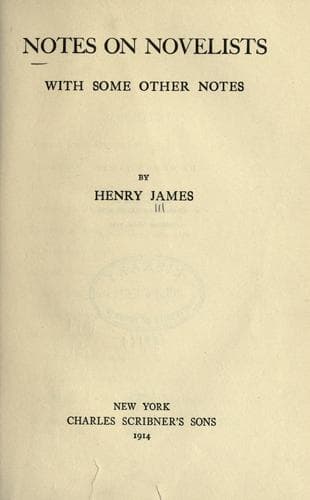
Notes on Novelists, with Some Other NotesJames, Henry
History
Notes on Novelists, with Some Other Notes
James, Henry
Fiction -- History and criticism; Novelists
childhood’s nursery and school-room, that of the moral tale of Miss
Edgeworth and Mr. Thomas Day.
Yet let not these restrictions be my last word. I had intended, under
the effect of a reperusal of “La Débâcle,” “Germinal” and “L’Assommoir,”
to make no discriminations that should not be in our hero’s favour. The
long-drawn incident of the marriage of Gervaise and Cadet-Cassis and
that of the Homeric birthday feast later on in the laundress’s workshop,
each treated from beginning to end and in every item of their coarse
comedy and humanity, still show the unprecedented breadth by which they
originally made us stare, still abound in the particular kind and degree
of vividness that helped them, when they appeared, to mark a date in the
portrayal of manners. Nothing had then been so sustained and at every
moment of its grotesque and pitiful existence lived into as the nuptial
day of the Coupeau pair in especial, their fantastic processional
pilgrimage through the streets of Paris in the rain, their bedraggled
exploration of the halls of the Louvre museum, lost as in the labyrinth
of Crete, and their arrival at last, ravenous and exasperated, at the
_guinguette_ where they sup at so much a head, each paying, and where we
sit down with them in the grease and the perspiration and succumb, half
in sympathy, half in shame, to their monstrous pleasantries, acerbities
and miseries. I have said enough of the mechanical in Zola; here in
truth is, given the elements, almost insupportably the sense of life.
That effect is equally in the historic chapter of the strike of the
miners in “Germinal,” another of those illustrative episodes, viewed as
great passages to be “rendered,” for which our author established
altogether a new measure and standard of handling, a new energy and
veracity, something since which the old trivialities and poverties of
treatment of such aspects have become incompatible, for the novelist,
with either rudimentary intelligence or rudimentary self-respect.
Public-domain text, read in full here on John Shaqi.
Reviews
Reviews
No reviews yet
Be the first to share your thoughts on this work.
Join the Discussion
Join the discussion
Sign in to leave a comment or review.
Sign InorCreate an account