Notes on Novelists, with Some Other Notes — John Shaqi
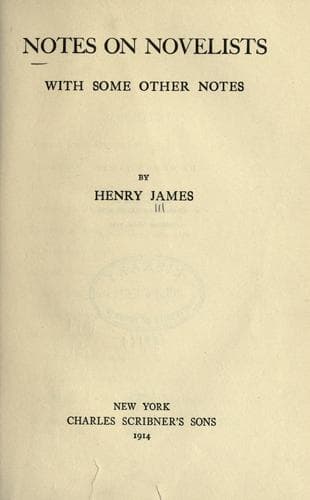
Notes on Novelists, with Some Other NotesJames, Henry
History
Notes on Novelists, with Some Other Notes
James, Henry
Fiction -- History and criticism; Novelists
The extraordinary thing, however, is that on the single occasion when,
publicly—as his whole manifestation was public—life did swoop down on
him, the effect of the visitation was quite perversely other than might
have been looked for. His courage in the Dreyfus connection testified
admirably to his ability to live for himself and out of the order of his
volumes—little indeed as living at all might have seemed a question for
one exposed, when his crisis was at its height and he was found guilty
of “insulting” the powers that were, to be literally torn to pieces in
the precincts of the Palace of Justice. Our point is that nothing was
ever so odd as that these great moments should appear to have been
wasted, when all was said, for his creative intelligence. “Vérité,” as I
have intimated, the production in which they might most have been
reflected, is a production unrenewed and unrefreshed by them, spreads
before us as somehow flatter and greyer, not richer and more relieved,
by reason of them. They really arrived, I surmise, too late in the day;
the imagination they might have vivified was already fatigued and spent.
I must not moreover appear to say that the power to evoke and present
has not even on the dead level of “Vérité” its occasional minor
revenges. There are passages, whole pages, of the old full-bodied sort,
pictures that elsewhere in the series would in all likelihood have
seemed abundantly convincing. Their misfortune is to have been
discounted by our intensified, our finally fatal sense of the _procédé_.
Quarrelling with all conventions, defiant of them in general, Zola was
yet inevitably to set up his own group of them—as, for that matter,
without a sufficient collection, without their aid in simplifying and
making possible, how could he ever have seen his big ship into port? Art
welcomes them, feeds upon them always; no sort of form is practicable
without them. It is only a question of what particular ones we use—to
wage war on certain others and to arrive at particular forms. The
convention of the blameless being, the thoroughly “scientific” creature
possessed impeccably of all truth and serving as the mouthpiece of it
and of the author’s highest complacencies, this character is for
instance a convention inveterate and indispensable, without whom the
“sympathetic” side of the work could never have been achieved. Marc in
“Vérité,” Pierre Froment in “Lourdes” and in “Rome,” the wondrous
representatives of the principle of reproduction in “Fécondité,” the
exemplary painter of “L’Œuvre,” sublime in his modernity and paternity,
the patient Jean Macquart of “La Débâcle,” whose patience is as
guaranteed as the exactitude of a well-made watch, the supremely
enlightened Docteur Pascal even, as I recall him, all amorous nepotism
but all virtue too and all beauty of life—such figures show us the
reasonable and the good not merely in the white light of the old George
Sand novel and its improved moralities, but almost in that of our
Public-domain text, read in full here on John Shaqi.
Reviews
Reviews
No reviews yet
Be the first to share your thoughts on this work.
Join the Discussion
Join the discussion
Sign in to leave a comment or review.
Sign InorCreate an account