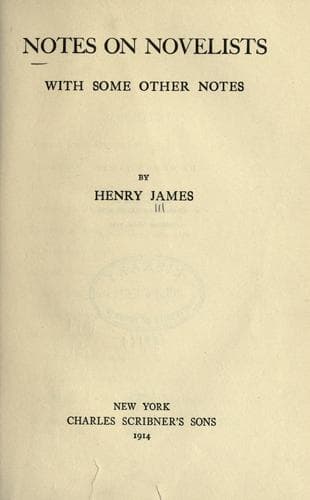
Notes on Novelists, with Some Other NotesJames, Henry
History
Notes on Novelists, with Some Other Notes
James, Henry
Fiction -- History and criticism; Novelists
but florid too and resonant, and my main remembrance is of a conception
of courtesy in him, an accessibility to the human relation, that only
wanted to be sure of the way taken or to take. The uncertainties of the
French for the determination of intercourse have often struck me as
quite matching the sharpness of their certainties, as we for the most
part feel these latter, which sometimes in fact throw the indeterminate
into almost touching relief. I have thought of them at such times as the
people in the world one may have to go more of the way to meet than to
meet any other, and this, as it were, through their being seated and
embedded, provided for at home, in a manner that is all their own and
that has bred them to the positive preacceptance of interest on their
behalf. We at least of the Anglo-American race, more abroad in the
world, perching everywhere, so far as grounds of intercourse are
concerned, more vaguely and superficially, as well as less
intelligently, are the more ready by that fact with inexpensive
accommodations, rather conscious that these themselves forbear from the
claim to fascinate, and advancing with the good nature that is the
mantle of our obtuseness to any point whatever where entertainment may
be offered us. My recollection is at any rate simplified by the fact of
the presence almost always, in the little high room of the Faubourg’s
end, of other persons and other voices. Flaubert’s own voice is clearest
to me from the uneffaced sense of a winter week-day afternoon when I
found him by exception alone and when something led to his reading me
aloud, in support of some judgment he had thrown off, a poem of
Théophile Gautier’s. He cited it as an example of verse intensely and
distinctively French, and French in its melancholy, which neither Goethe
nor Heine nor Leopardi, neither Pushkin nor Tennyson nor, as he said,
Byron, could at all have matched in _kind_. He converted me at the
moment to this perception, alike by the sense of the thing and by his
large utterance of it; after which it is dreadful to have to confess not
only that the poem was then new to me, but that, hunt as I will in every
volume of its author, I am never able to recover it. This is perhaps
after all happy, causing Flaubert’s own full tone, which was the note of
the occasion, to linger the more unquenched. But for the rhyme in fact I
could have believed him to be spouting to me something strange and
sonorous of his own. The thing really rare would have been to hear him
do that—hear him _gueuler_, as he liked to call it. Verse, I felt, we
had always with us, and almost any idiot of goodwill could give it a
value. The value of so many a passage of “Salammbô” and of “L’Éducation”
was on the other hand exactly such as gained when he allowed himself, as
had by the legend ever been frequent _dans l’intimité_, to “bellow” it
to its fullest effect.
Public-domain text, read in full here on John Shaqi.
Reviews
Reviews
No reviews yet
Be the first to share your thoughts on this work.
Elsewhere in the archive
Join the Discussion
Join the discussion
Sign in to leave a comment or review.
Sign InorCreate an account