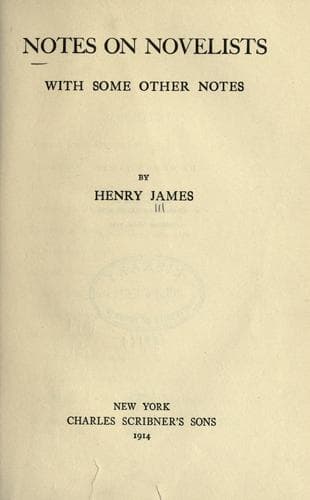
Notes on Novelists, with Some Other NotesJames, Henry
History
Notes on Novelists, with Some Other Notes
James, Henry
Fiction -- History and criticism; Novelists
His imagination was great and splendid; in spite of which, strangely
enough, his masterpiece is not his most imaginative work. “Madame
Bovary,” beyond question, holds that first place, and “Madame Bovary” is
concerned with the career of a country doctor’s wife in a petty Norman
town. The elements of the picture are of the fewest, the situation of
the heroine almost of the meanest, the material for interest,
considering the interest yielded, of the most unpromising; but these
facts only throw into relief one of those incalculable incidents that
attend the proceedings of genius. “Madame Bovary” was doomed by
circumstances and causes—the freshness of comparative youth and good
faith on the author’s part being perhaps the chief—definitely to take
its position, even though its subject was fundamentally a negation of
the remote, the splendid and the strange, the stuff of his fondest and
most cultivated dreams. It would have seemed very nearly to exclude the
free play of the imagination, and the way this faculty on the author’s
part nevertheless presides is one of those accidents, manœuvres,
inspirations, we hardly know what to call them, by which masterpieces
grow. He of course knew more or less what he was doing for his book in
making Emma Bovary a victim of the imaginative habit, but he must have
been far from designing or measuring the total effect which renders the
work so general, so complete an expression of himself. His separate
idiosyncrasies, his irritated sensibility to the life about him, with
the power to catch it in the fact and hold it hard, and his hunger for
style and history and poetry, for the rich and the rare, great
reverberations, great adumbrations, are here represented together as
they are not in his later writings. There is nothing of the near, of the
directly observed, though there may be much of the directly perceived
and the minutely detailed, either in “Salammbô” or in “Saint-Antoine,”
and little enough of the extravagance of illusion in that indefinable
last word of restrained evocation and cold execution “L’Éducation
Sentimentale.” M. Faguet has of course excellently noted this—that the
fortune and felicity of the book were assured by the stroke that made
the central figure an embodiment of helpless romanticism. Flaubert
himself but narrowly escaped being such an embodiment after all, and he
is thus able to express the romantic mind with extraordinary truth. As
to the rest of the matter he had the luck of having been in possession
from the first, having begun so early to nurse and work up his plan
that, familiarity and the native air, the native soil, aiding, he had
finally made out to the last lurking shade the small sordid sunny dusty
village picture, its emptiness constituted and peopled. It is in the
background and the accessories that the real, the real of his theme,
abides; and the romantic, the romantic of his theme, accordingly
occupies the front. Emma Bovary’s poor adventures are a tragedy for the
Public-domain text, read in full here on John Shaqi.
Reviews
Reviews
No reviews yet
Be the first to share your thoughts on this work.
Elsewhere in the archive
Join the Discussion
Join the discussion
Sign in to leave a comment or review.
Sign InorCreate an account