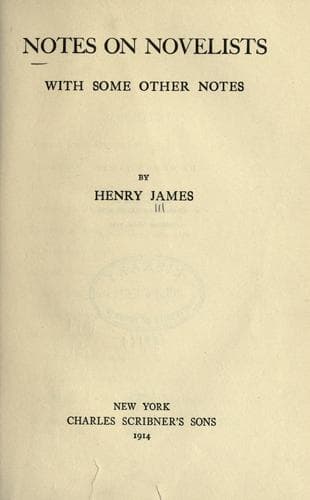
Notes on Novelists, with Some Other NotesJames, Henry
History
Notes on Novelists, with Some Other Notes
James, Henry
Fiction -- History and criticism; Novelists
very reason that in a world unsuspecting, unassisting, unconsoling, she
has herself to distil the rich and the rare. Ignorant, unguided,
undiverted, ridden by the very nature and mixture of her consciousness,
she makes of the business an inordinate failure, a failure which in its
turn makes for Flaubert the most pointed, the most _told_ of anecdotes.
There are many things to say about “Madame Bovary,” but an old admirer
of the book would be but half-hearted—so far as they represent reserves
or puzzlements—were he not to note first of all the circumstances by
which it is most endeared to him. To remember it from far back is to
have been present all along at a process of singular interest to a
literary mind, a case indeed full of comfort and cheer. The finest of
Flaubert’s novels is to-day, on the French shelf of fiction, one of the
first of the classics; it has attained that position, slowly but
steadily, before our eyes; and we seem so to follow the evolution of the
fate of a classic. We see how the thing takes place; which we rarely
can, for we mostly miss either the beginning or the end, especially in
the case of a consecration as complete as this. The consecrations of the
past are too far behind and those of the future too far in front. That
the production before us _should_ have come in for the heavenly crown
may be a fact to offer English and American readers a mystifying side;
but it is exactly our ground and a part moreover of the total interest.
The author of these remarks remembers, as with a sense of the way such
things happen, that when a very young person in Paris he took up from
the parental table the latest number of the periodical in which
Flaubert’s then duly unrecognised masterpiece was in course of
publication. The moment is not historic, but it was to become in the
light of history, as may be said, so unforgettable that every small
feature of it yet again lives for him: it rests there like the backward
end of the span. The cover of the old Revue de Paris was yellow, if I
mistake not, like that of the new, and “Madame Bovary: Mœurs de
Province,” on the inside of it, was already, on the spot, as a title,
mysteriously arresting, inscrutably charged. I was ignorant of what had
preceded and was not to know till much later what followed; but present
to me still is the act of standing there before the fire, my back
against the low beplushed and begarnished French chimney-piece and
taking in what I might of that instalment, taking it in with so
surprised an interest, and perhaps as well such a stir of faint
foreknowledge, that the sunny little salon, the autumn day, the window
ajar and the cheerful outside clatter of the Rue Montaigne are all now
for me more or less in the story and the story more or less in them. The
story, however, was at that moment having a difficult life; its fortune
was all to make; its merit was so far from suspected that, as Maxime Du
Camp—though verily with no excess of contrition—relates, its cloth of
Public-domain text, read in full here on John Shaqi.
Reviews
Reviews
No reviews yet
Be the first to share your thoughts on this work.
Elsewhere in the archive
Join the Discussion
Join the discussion
Sign in to leave a comment or review.
Sign InorCreate an account