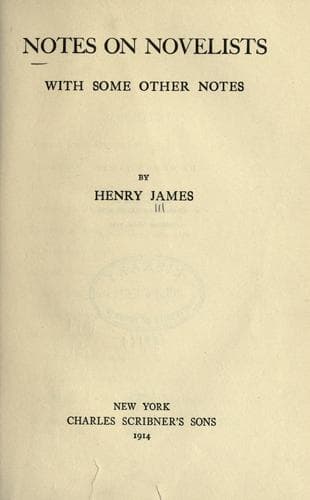
Notes on Novelists, with Some Other NotesJames, Henry
History
Notes on Novelists, with Some Other Notes
James, Henry
Fiction -- History and criticism; Novelists
And yet it is not after all that the place the book has taken is so
overwhelmingly explained by its inherent dignity; for here comes in the
curiosity of the matter. Here comes in especially its fund of admonition
for alien readers. The dignity of its substance is the dignity of Madame
Bovary herself as a vessel of experience—a question as to which,
unmistakably, I judge, we can only depart from the consensus of French
critical opinion. M. Faguet for example commends the character of the
heroine as one of the most living and discriminated figures of women in
all literature, praises it as a field for the display of the romantic
spirit that leaves nothing to be desired. Subject to an observation I
shall presently make and that bears heavily in general, I think, on
Flaubert as a painter of life, subject to this restriction he is right;
which is a proof that a work of art may be markedly open to objection
and at the same time be rare in its kind, and that when it is perfect to
this point nothing else particularly matters. “Madame Bovary” has a
perfection that not only stamps it, but that makes it stand almost
alone; it holds itself with such a supreme unapproachable assurance as
both excites and defies judgment. For it deals not in the least, as to
unapproachability, with things exalted or refined; it only confers on
its sufficiently vulgar elements of exhibition a final unsurpassable
form. The form is in _itself_ as interesting, as active, as much of the
essence of the subject as the idea, and yet so close is its fit and so
inseparable its life that we catch it at no moment on any errand of its
own. That verily is to _be_ interesting—all round; that is to be
genuine and whole. The work is a classic because the thing, such as it
is, is ideally _done_, and because it shows that in such doing eternal
beauty may dwell. A pretty young woman who lives, socially and morally
speaking, in a hole, and who is ignorant, foolish, flimsy, unhappy,
takes a pair of lovers by whom she is successively deserted; in the
midst of the bewilderment of which, giving up her husband and her child,
letting everything go, she sinks deeper into duplicity, debt, despair,
and arrives on the spot, on the small scene itself of her poor
depravities, at a pitiful tragic end. In especial she does these things
while remaining absorbed in romantic intention and vision, and she
remains absorbed in romantic intention and vision while fairly rolling
in the dust. That is the triumph of the book as the triumph stands, that
Emma interests us by the nature of her consciousness and the play of her
mind, thanks to the reality and beauty with which those sources are
invested. It is not only that they represent _her_ state; they are so
true, so observed and felt, and especially so shown, that they represent
the state, actual or potential, of all persons like her, persons
romantically determined. Then her setting, the medium in which she
Public-domain text, read in full here on John Shaqi.
Reviews
Reviews
No reviews yet
Be the first to share your thoughts on this work.
Elsewhere in the archive
Join the Discussion
Join the discussion
Sign in to leave a comment or review.
Sign InorCreate an account