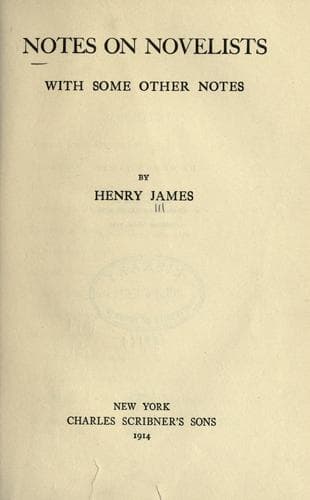
Notes on Novelists, with Some Other NotesJames, Henry
History
Notes on Novelists, with Some Other Notes
James, Henry
Fiction -- History and criticism; Novelists
struggles, becomes in its way as important, becomes eminent with the
eminence of art; the tiny world in which she revolves, the contracted
cage in which she flutters, is hung out in space for her, and her
companions in captivity there are as true as herself.
I have said enough to show what I mean by Flaubert’s having in this
picture expressed something of his intimate self, given his heroine
something of his own imagination: a point precisely that brings me back
to the restriction at which I just now hinted, in which M. Faguet fails
to indulge and yet which is immediate for the alien reader. Our
complaint is that Emma Bovary, in spite of the nature of her
consciousness and in spite of her reflecting so much that of her
creator, is really too small an affair. This, critically speaking, is in
view both of the value and the fortune of her history, a wonderful
circumstance. She associates herself with Frédéric Moreau in
“L’Éducation” to suggest for us a question that can be answered, I hold,
only to Flaubert’s detriment. Emma taken alone would possibly not so
directly press it, but in her company the hero of our author’s second
study of the “real” drives it home. Why did Flaubert choose, as special
conduits of the life he proposed to depict, such inferior and in the
case of Frédéric such abject human specimens? I insist only in respect
to the latter, the perfection of Madame Bovary scarce leaving one much
warrant for wishing anything other. Even here, however, the general
scale and size of Emma, who is small even of her sort, should be a
warning to hyperbole. If I say that in the matter of Frédéric at all
events the answer is inevitably detrimental I mean that it weighs
heavily on our author’s general credit. He wished in each case to make a
picture of experience—middling experience, it is true—and of the world
close to him; but if he imagined nothing better for his purpose than
such a heroine and such a hero, both such limited reflectors and
registers, we are forced to believe it to have been by a defect of his
mind. And that sign of weakness remains even if it be objected that the
images in question were addressed to his purpose better than others
would have been: the purpose itself then shows as inferior. “L’Éducation
Sentimentale” is a strange, an indescribable work, about which there
would be many more things to say than I have space for, and all of them
of the deepest interest. It is moreover, to simplify my statement, very
much less satisfying a thing, less pleasing whether in its unity or its
variety, than its specific predecessor. But take it as we will, for a
success or a failure—M. Faguet indeed ranks it, by the measure of its
quantity of intention, a failure, and I on the whole agree with him—the
personage offered us as bearing the weight of the drama, and in whom we
are invited to that extent to interest ourselves, leaves us mainly
wondering what our entertainer could have been thinking of. He takes
Public-domain text, read in full here on John Shaqi.
Reviews
Reviews
No reviews yet
Be the first to share your thoughts on this work.
Elsewhere in the archive
Join the Discussion
Join the discussion
Sign in to leave a comment or review.
Sign InorCreate an account