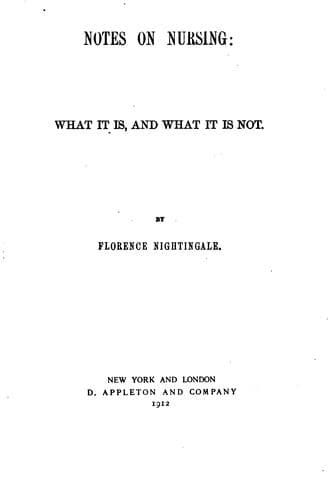
Notes on Nursing: What It Is, and What It Is NotNightingale, Florence
Science
Notes on Nursing: What It Is, and What It Is Not
Nightingale, Florence
Nursing
I have heard a doctor condemned whose patient did not, alas! recover,
because another doctor's patient of a _different_ sex, of a _different_
age, recovered from a _different_ disease, in a _different_ place. Yes,
this is really true. If people who make these comparisons did but know
(only they do not care to know), the care and preciseness with which
such comparisons require to be made, (and are made,) in order to be of
any value whatever, they would spare their tongues. In comparing the
deaths of one hospital with those of another, any statistics are justly
considered absolutely valueless which do not give the ages, the sexes,
and the diseases of all the cases. It does not seem necessary to mention
this. It does not seem necessary to say that there can be no comparison
between old men with dropsies and young women with consumptions. Yet the
cleverest men and the cleverest women are often heard making such
comparisons, ignoring entirely sex, age, disease, place--in fact, _all_
the conditions essential to the question. It is the merest _gossip_.
[2]
A small pet animal is often an excellent companion for the sick, for
long chronic cases especially. A pet bird in a cage is sometimes the
only pleasure of an invalid confined for years to the same room. If he
can feed and clean the animal himself, he ought always to be encouraged
to do so.
XIII. OBSERVATION OF THE SICK.
[Sidenote: What is the use of the question, Is he better?]
There is no more silly or universal question scarcely asked than this,
"Is he better?" Ask it of the medical attendant, if you please. But of
whom else, if you wish for a real answer to your question, would you
ask? Certainly not of the casual visitor; certainly not of the nurse,
while the nurse's observation is so little exercised as it is now. What
you want are facts, not opinions--for who can have any opinion of any
value as to whether the patient is better or worse, excepting the
constant medical attendant, or the really observing nurse?
The most important practical lesson that can be given to nurses is to
teach them what to observe--how to observe--what symptoms indicate
improvement--what the reverse--which are of importance--which are of
none--which are the evidence of neglect--and of what kind of neglect.
All this is what ought to make part, and an essential part, of the
training of every nurse. At present how few there are, either
professional or unprofessional, who really know at all whether any sick
person they may be with is better or worse.
The vagueness and looseness of the information one receives in answer to
that much abused question, "Is he better?" would be ludicrous, if it
were not painful. The only sensible answer (in the present state of
knowledge about sickness) would be "How can I know? I cannot tell how he
was when I was not with him."
Public-domain text, read in full here on John Shaqi.
Reviews
Reviews
No reviews yet
Be the first to share your thoughts on this work.
Elsewhere in the archive
Join the Discussion
Join the discussion
Sign in to leave a comment or review.
Sign InorCreate an account