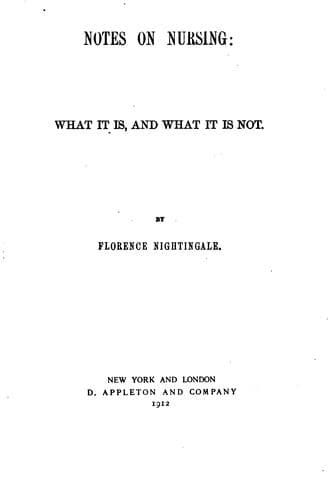
Notes on Nursing: What It Is, and What It Is NotNightingale, Florence
Science
Notes on Nursing: What It Is, and What It Is Not
Nightingale, Florence
Nursing
I can record but a very few specimens of the answers[1] which I have
heard made by friends and nurses, and accepted by physicians and
surgeons at the very bed-side of the patient, who could have
contradicted every word, but did not--sometimes from amiability, often
from shyness, oftenest from languor!
"How often have the bowels acted, nurse?" "Once, sir." This generally
means that the utensil has been emptied once, it having been used
perhaps seven or eight times.
"Do you think the patient is much weaker than he was six weeks ago?" "Oh
no, sir; you know it is very long since he has been up and dressed, and
he can get across the room now." This means that the nurse has not
observed that whereas six weeks ago he sat up and occupied himself in
bed, he now lies still doing nothing; that, although he can "get across
the room," he cannot stand for five seconds.
Another patient who is eating well, recovering steadily, although
slowly, from fever, but cannot walk or stand, is represented to the
doctor as making no progress at all.
[Sidenote: Leading questions useless or misleading.]
Questions, too, as asked now (but too generally) of or about patients,
would obtain no information at all about them, even if the person asked
of had every information to give. The question is generally a leading
question; and it is singular that people never think what must be the
answer to this question before they ask it: for instance, "Has he had a
good night?" Now, one patient will think he has a bad night if he has
not slept ten hours without waking. Another does not think he has a bad
night if he has had intervals of dosing occasionally. The same answer
has, actually been given as regarded two patients--one who had been
entirely sleepless for five times twenty-four hours, and died of it, and
another who had not slept the sleep of a regular night, without waking.
Why cannot the question be asked, How many hours' sleep has ---- had?
and at what hours of the night?[2] "I have never closed my eyes all
night," an answer as frequently made when the speaker has had several
hours' sleep as when he has had none, would then be less often said.
Lies, intentional and unintentional, are much seldomer told in answer to
precise than to leading questions. Another frequent error is to inquire
whether one cause remains, and not whether the effect which may be
produced by a great many different causes, _not_ inquired after,
remains. As when it is asked, whether there was noise in the street last
night; and if there were not, the patient is reported, without more ado,
to have had a good night. Patients are completely taken aback by these
kinds of leading questions, and give only the exact amount of
information asked for, even when they know it to be completely
misleading. The shyness of patients is seldom allowed for.
How few there are who, by five or six pointed questions, can elicit the
whole case, and get accurately to know and to be able to report _where_
the patient is.
Public-domain text, read in full here on John Shaqi.
Reviews
Reviews
No reviews yet
Be the first to share your thoughts on this work.
Elsewhere in the archive
Join the Discussion
Join the discussion
Sign in to leave a comment or review.
Sign InorCreate an account