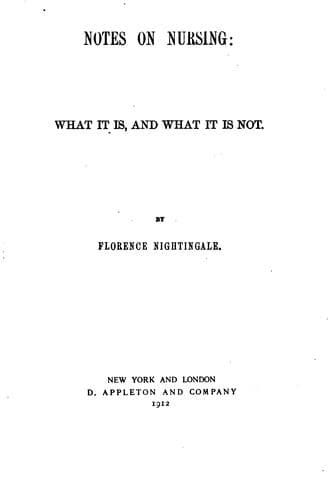
Notes on Nursing: What It Is, and What It Is NotNightingale, Florence
Science
Notes on Nursing: What It Is, and What It Is Not
Nightingale, Florence
Nursing
[3]
[Sidenote: More important to spare the patient thought than physical
exertion.]
It is commonly supposed that the nurse is there to spare the
patient from making physical exertion for himself--I would rather
say that she ought to be there to spare him from taking thought
for himself. And I am quite sure, that if the patient were spared
all thought for himself, and _not_ spared all physical exertion, he
would be infinitely the gainer. The reverse is generally the case
in the private house. In the hospital it is the relief from all
anxiety, afforded by the rules of a well-regulated institution,
which has often such a beneficial effect upon the patient.
[4]
[Sidenote: English women have great capacity of, but little practice in
close observation.]
It may be too broad an assertion, and it certainly sounds like a
paradox. But I think that in no country are women to be found so
deficient in ready and sound observation as in England, while peculiarly
capable of being trained to it. The French or Irish woman is too quick
of perception to be so sound an observer--the Teuton is too slow to be
so ready an observer as the English woman might be. Yet English women
lay themselves open to the charge so often made against them by men,
viz., that they are not to be trusted in handicrafts to which their
strength is quite equal, for want of a practised and steady observation.
In countries where women (with average intelligence certainly not
superior to that of English women) are employed, e.g., in dispensing,
men responsible for what these women do (not theorizing about man's and
woman's "missions,") have stated that they preferred the service of
women to that of men, as being more exact, more careful, and incurring
fewer mistakes of inadvertence.
Now certainly English women are peculiarly capable of attaining to this.
I remember when a child, hearing the story of an accident, related by
some one who sent two girls to fetch a "bottle of salvolatile from her
room;" "Mary could not stir," she said, "Fanny ran and fetched a bottle
that was not salvolatile, and that was not in my room."
Now this sort of thing pursues every one through life. A woman is asked
to fetch a large new bound red book, lying on the table by the window,
and she fetches five small old boarded brown books lying on the shelf by
the fire. And this, though she has "put that room to rights" every day
for a month perhaps, and must have observed the books every day, lying
in the same places, for a month, if she had any observation.
Habitual observation is the more necessary, when any sudden call arises.
If "Fanny" had observed "the bottle of salvolatile" in "the aunt's
room," every day she was there, she would more probably have found it
when it was suddenly wanted.
There are two causes for these mistakes of inadvertence. 1. A want of
ready attention; only a part of the request is heard at all. 2. A want
of the habit of observation.
Public-domain text, read in full here on John Shaqi.
Reviews
Reviews
No reviews yet
Be the first to share your thoughts on this work.
Elsewhere in the archive
Join the Discussion
Join the discussion
Sign in to leave a comment or review.
Sign InorCreate an account