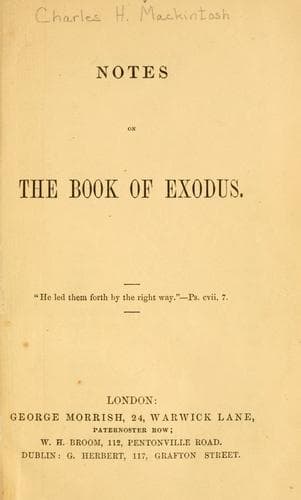
Notes on the book of ExodusMackintosh, Charles Henry
Religion
Notes on the book of Exodus
Mackintosh, Charles Henry
Bible. Exodus -- Commentaries
We are furnished, in the last few verses of Exodus xiii, with a
touching and beautiful example of the Lord's tender consideration of
His people's need. "He knoweth our frame; He remembereth that we are
dust." (Psalm ciii. 14.) When He redeemed Israel and took them into
relationship with Himself, He, in His unfathomed and infinite grace,
charged Himself with all their need and weakness. It mattered not what
they were or what they needed when I AM was with them, in all the
exhaustless treasures of that name. He had to conduct them from Egypt
to Canaan, and we here find Him occupying Himself in selecting a
suitable path for them.--"And it came to pass, when Pharaoh had let
the people go, that God led them not through the way of the land of
the Philistines, although that was near; for God said, 'Lest
peradventure the people repent when they see war, and they return to
Egypt;' but God led the people about through the way of the wilderness
of the Red Sea." (Ver. 17, 18.)
The Lord, in His condescending grace, so orders for His people that
they do not, at their first setting out, encounter heavy trials, which
might have the effect of discouraging their hearts and driving them
back. "The way of the wilderness" was a much more protracted route;
but God had deep and varied lessons to teach His people, which could
only be learnt in the desert. They were afterwards reminded of this
fact, in the following passage: "And thou shalt remember all the way
which the Lord thy God led thee these forty years in the wilderness,
to humble thee, and to prove thee, to know what was in thine heart,
whether thou wouldest keep His commandments or no. And He humbled
thee, and suffered thee to hunger, and fed thee with manna, which thou
knewest not, neither did thy fathers know; that He might make thee
know that man doth not live by bread only, but by every word that
proceedeth out of the mouth of the Lord doth man live. Thy raiment
waxed not old upon thee, neither did thy foot swell, these forty
years." (Deut. viii. 2-4.) Such precious lessons as these could never
have been learnt in "the way of the land of the Philistines." In that
way, they might have learnt what _war_ was, at an early stage of their
career; but "in the way of the wilderness," they learnt what _flesh_
was, in all its crookedness, unbelief, and rebellion. But I AM was
there, in all His patient grace, unerring wisdom, and infinite power.
None but Himself could have met the demand; none but He could endure
the opening up of the depths of a human heart. To have my heart
unlocked any where, save in the presence of infinite grace, would
plunge me in hopeless despair. The heart of man is but a little hell.
What boundless mercy, then, to be delivered from its terrible depths!
"Oh, to grace how great a debtor
Daily I'm constrained to be!
Let that grace, Lord, like a fetter,
Bind my wandering heart to Thee!"
Public-domain text, read in full here on John Shaqi.
Reviews
Reviews
No reviews yet
Be the first to share your thoughts on this work.
Elsewhere in the archive
Join the Discussion
Join the discussion
Sign in to leave a comment or review.
Sign InorCreate an account