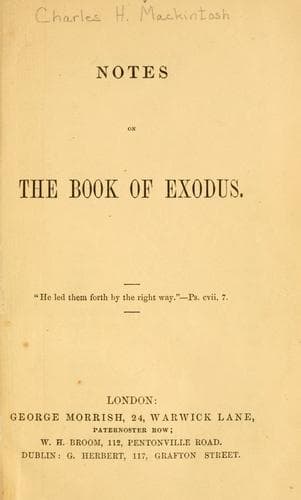
Notes on the book of ExodusMackintosh, Charles Henry
Religion
Notes on the book of Exodus
Mackintosh, Charles Henry
Bible. Exodus -- Commentaries
It is in the day of trial and difficulty that the soul experiences
something of the deep and untold blessedness of being able to count on
God. Were all to go on smoothly, this would not be so. It is not in
gliding along the surface of a tranquil lake that the reality of the
Master's presence is felt; but actually when the tempest roars, and
the waves roll over the ship. The Lord does not hold out to us the
prospect of exemption from trial and tribulation; quite the opposite:
He tells us we shall have to meet both the one and the other; but He
promises to be with us in them, and this is infinitely better. God's
presence _in_ the trial is much better than exemption _from_ the
trial. The sympathy of His heart _with us_ is sweeter far than the
power of His hand _for us_. The Master's presence with His faithful
servants while passing through the furnace was better far than the
display of His power to keep them out of it. (Dan. iii.) We would
frequently desire to be allowed to pass on our way without trial, but
this would involve serious loss. The Lord's presence is never so sweet
as in moments of appalling difficulty.
Thus it was in Israel's case, as recorded in this chapter. They are
brought into an overwhelming difficulty: they are called to "do
business in great waters:" "they are at their wit's end." Pharaoh,
repenting himself of having let them go out of his land, determines
to make one desperate effort to recover them. "And he made ready his
chariot, and took his people with him; and he took six hundred chosen
chariots, and all the chariots of Egypt, and captains over every one
of them.... And when Pharaoh drew nigh, the children of Israel lifted
up their eyes, and, behold, the Egyptians marched after them; and they
were sore afraid: and the children of Israel cried out unto the Lord."
Here was a deeply trying scene--one in which human effort could avail
nothing. As well might they have attempted to put back with a straw
the ocean's mighty tide, as seek to extricate themselves by aught that
they could do. The sea was before them, Pharaoh's hosts behind them,
and the mountains around them. And all this, be it observed, permitted
and ordered of God. He had marked out their position before
"Pi-hahiroth, between Migdol and the sea, over against Baal-zephon."
Moreover, He permitted Pharaoh to come upon them. And why? Just to
display Himself in the salvation of His people, and the total
overthrow of their enemies. "To Him that divided the Red Sea into
parts: for His mercy endureth forever: and made Israel to pass through
the midst of it: for His mercy endureth forever: but overthrew Pharaoh
and his host in the Red Sea: for His mercy endureth forever." (Ps.
cxxxvi.)
Public-domain text, read in full here on John Shaqi.
Reviews
Reviews
No reviews yet
Be the first to share your thoughts on this work.
Elsewhere in the archive
Join the Discussion
Join the discussion
Sign in to leave a comment or review.
Sign InorCreate an account