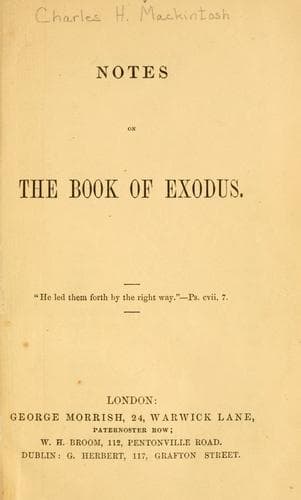
Notes on the book of ExodusMackintosh, Charles Henry
Religion
Notes on the book of Exodus
Mackintosh, Charles Henry
Bible. Exodus -- Commentaries
But some feel disposed to ask the question, "Are we not to do
anything?" This maybe answered by asking another, namely, What can we
do? All who really know themselves must answer, Nothing. If,
therefore, we can do nothing, had we not better "stand still"? If the
Lord is acting for us, had we not better stand back? Shall we run
before Him? Shall we busily intrude ourselves upon His sphere of
action? Shall we come in His way? There can be no possible use in two
acting, when one is so perfectly competent to do all. No one would
think of bringing a lighted candle to add brightness to the sun at
midday: and yet the man who would do so might well be accounted wise,
in comparison with him who attempts to assist God by his bustling
officiousness.
However, when God, in His great mercy, opens the way, faith can walk
therein. It only ceases from man's way in order to walk in God's. "And
the Lord said unto Moses, 'Wherefore criest thou unto Me? Speak unto
the children of Israel that they go forward.'" It is only when we have
learnt to "stand still" that we are able effectually to go forward. To
attempt the latter until we have learnt the former is sure to issue in
the exposure of our folly and weakness. It is therefore true wisdom,
in all times of difficulty and perplexity, to "stand still"--to wait
only upon God, and He will assuredly open a way for us; and then we
can peacefully and happily "go forward." There is no uncertainty when
God makes a way for us; but every self-devised path must prove a path
of doubt and hesitation. The unregenerate man may move along with
great apparent firmness and decision in his own ways; but one of the
most distinct elements in the new creation is self-distrust, and the
element which answers thereto is confidence in God. It is when our
eyes have seen God's salvation that we can walk therein; but this can
never be distinctly seen until we have been brought to the end of our
own poor doings.
There is peculiar force and beauty in the expression, "_See_ the
salvation of God." The very fact of our being called to "see" God's
salvation, proves that the salvation is a complete one. It teaches
that salvation is a thing wrought out and revealed by God, to be seen
and enjoyed by us. It is not a thing made up partly of God's doing and
partly of man's. Were it so, it could not be called _God's_ salvation.
In order to be His, it must be wholly divested of everything
pertaining to man. The only possible effect of human efforts is to
raise a dust which obscures the view of God's salvation.
Public-domain text, read in full here on John Shaqi.
Reviews
Reviews
No reviews yet
Be the first to share your thoughts on this work.
Elsewhere in the archive
Join the Discussion
Join the discussion
Sign in to leave a comment or review.
Sign InorCreate an account