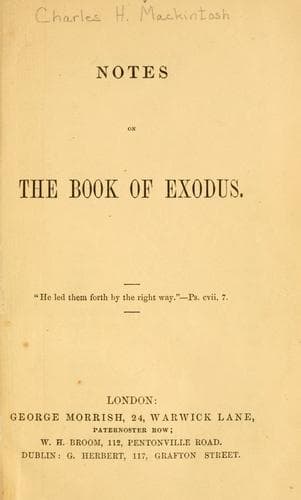
Notes on the book of ExodusMackintosh, Charles Henry
Religion
Notes on the book of Exodus
Mackintosh, Charles Henry
Bible. Exodus -- Commentaries
In the same manner, the believer may look for his difficulties, and
not find them, because God is between him and them. If, therefore, the
eye, instead of resting on our sins and sorrows, could rest only upon
Christ, it would sweeten many a bitter cup, and enlighten many a
gloomy hour. But one finds constantly that nine-tenths of our trials
and sorrows are made up of anticipated or imaginary evils, which only
exist in our own disordered, because unbelieving, minds. May my reader
know the solid peace, both of heart and conscience, which results
from having Christ, in all His fullness, between him and _all_ his
sins and _all_ his sorrows.
It is at once most solemn and interesting to note the double aspect of
the "pillar" in this chapter. "It was a cloud and darkness" to the
Egyptians, but "it gave light by night" to Israel. How like the cross
of our Lord Jesus Christ! Truly, that cross has a double aspect
likewise. It forms the foundation of the believer's peace, and, at the
same time, seals the condemnation of a guilty world. The self-same
blood which purges the believer's conscience and gives him perfect
peace, stains this earth and consummates its guilt. The very mission
of the Son of God which strips the world of its cloak, and leaves it
wholly without excuse, clothes the Church with a fair mantle of
righteousness, and fills her mouth with ceaseless praise. The very
same Lamb who will terrify, by His unmitigated wrath, all tribes and
classes of earth, will lead, by His gentle hand, His blood-bought
flock through the green pastures and beside the still waters forever.
(Compare Rev. vi. 15-17 with vii. 13-17.)
The close of our chapter shows us Israel triumphant on the shore of
the Red Sea, and Pharaoh's hosts submerged beneath its waves. The
fears of the former and the boastings of the latter had both alike
been proved utterly groundless: Jehovah's glorious work had
annihilated both the one and the other. The same waters which formed a
wall for God's redeemed, formed a grave for Pharaoh. Thus it is ever:
those who walk by faith find a path to walk in, while all who assay
to do so find a grave. This is a solemn truth, which is not in any
wise weakened by the fact that Pharaoh was acting in avowed and
positive hostility to God when he "assayed" to pass through the Red
Sea. It will ever be found true that all who attempt to imitate
faith's actings will be confounded. Happy are they who are enabled,
however feebly, to walk by faith. They are moving along a path of
unspeakable blessedness,--a path which, though it may be marked by
failure and infirmity, is nevertheless "begun, continued, and ended in
God." O, that we may all enter more fully into the divine reality, the
calm elevation, and the holy independence of this path!
Public-domain text, read in full here on John Shaqi.
Reviews
Reviews
No reviews yet
Be the first to share your thoughts on this work.
Elsewhere in the archive
Join the Discussion
Join the discussion
Sign in to leave a comment or review.
Sign InorCreate an account