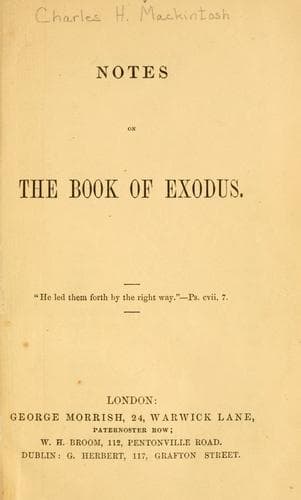
Notes on the book of ExodusMackintosh, Charles Henry
Religion
Notes on the book of Exodus
Mackintosh, Charles Henry
Bible. Exodus -- Commentaries
In this, as in everything else, they were our types. We, too, must
know ourselves as saved, in the power of death and resurrection,
before ever we can present clear and intelligent worship. There will
always be reserve and hesitancy in the soul, proceeding, no doubt,
from positive inability to enter into the accomplished redemption
which is in Christ Jesus. There may be the acknowledgment of the fact
that there is salvation in Christ, and in none other; but this is a
very different thing from apprehending, by faith, the true character
and ground of that salvation, and realizing it as _ours_. The Spirit
of God reveals, with unmistakable clearness, in the Word, that the
Church is united to Christ in death and resurrection; and, moreover,
that a risen Christ, at God's right hand, is the measure and pledge of
the Church's acceptance. When this is believed, it conducts the soul
entirely beyond the region of doubt and uncertainty. How can the
Christian doubt when he knows that he is continually represented
before the throne of God by an Advocate, even "Jesus Christ the
righteous"? It is the privilege of the very feeblest member of the
Church of God to know that he was represented by Christ on the
cross,--that _all_ his sins were confessed, borne, judged, and atoned
for there. This is a divine reality, and, when laid hold of by faith,
must give peace; but nothing short of it ever can give peace. There
may be earnest, anxious, and most sincere desires after God,--there
may be the most pious and devout attendance upon all the ordinances,
offices, and forms of religion; but there is no other possible way in
which to get the sense of sin entirely removed from the conscience,
but seeing it judged in the Person of Christ, as a sin-offering, on
the cursed tree. If it was judged there once for all, it is now by the
believer to be regarded as a divinely, and therefore eternally,
settled question; and that it was so judged is proved by the
resurrection of the Surety. "I know that whatsoever God doeth it shall
be forever: nothing can be put to it nor anything taken from it: and
God doeth it that men should fear before Him." (Ecc. iii. 14.)
Public-domain text, read in full here on John Shaqi.
Reviews
Reviews
No reviews yet
Be the first to share your thoughts on this work.
Elsewhere in the archive
Join the Discussion
Join the discussion
Sign in to leave a comment or review.
Sign InorCreate an account