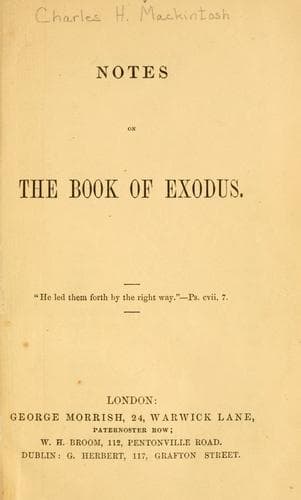
Notes on the book of ExodusMackintosh, Charles Henry
Religion
Notes on the book of Exodus
Mackintosh, Charles Henry
Bible. Exodus -- Commentaries
Now, we know that the Sabbath, as well as the manna, was a type. In
itself, it was a real blessing--a sweet mercy from the hand of a
loving and gracious God, who would relieve the toil and travail of a
sin-stricken earth by the refreshment of one day of rest out of the
seven. Whatever way we look at the institution of the Sabbath, we must
see it to be pregnant with richest mercy,--whether we view it in
reference to man or to the animal creation. And, albeit, that
Christians observe the first day of the week--the Lord's day--and
attach to it its proper principles, yet is the gracious providence
equally observable, nor would any mind at all governed by right
feelings, seek, for a moment, to interfere with such a signal mercy.
"The Sabbath was made for man;" and although man never has kept it,
according to the divine thought about it, that does not detract from
the grace which shines in the appointment of it, nor divest it of its
deep significancy as a type of that eternal rest which remains for the
people of God, or as a shadow of that substance which faith now enjoys
in the Person and work of a risen Christ.
Let not the reader therefore suppose that in any thing which has been
or may be stated in these pages the object is to touch, in the
slightest degree, the merciful provision of one day's rest for man and
the animal creation, much less to interfere with the distinct place
which the Lord's day occupies in the New Testament. Nothing is further
from the writer's thoughts. As a man he values the former, and as a
Christian he rejoices in the latter, far too deeply to admit of his
penning or uttering a single syllable which would interfere with
either the one or the other. He would only ask the reader to weigh,
with a dispassionate mind, in the balance of Holy Scripture, every
line and every statement, and not form any harsh judgment beforehand.
This subject will come before us again, in our further meditations, if
the Lord will. May we learn to value more the rest which our God has
provided for us in Christ, and while enjoying Him as our rest, may we
feed upon Him as the "hidden Manna," laid up, in the power of
resurrection, in the inner sanctuary,--the record of what God has
accomplished, on our behalf, by coming down into this world, in His
infinite grace, in order that we might be before Him according to the
perfectness of Christ, and feed on His unsearchable riches forever.
CHAPTER XVII.
Public-domain text, read in full here on John Shaqi.
Reviews
Reviews
No reviews yet
Be the first to share your thoughts on this work.
Elsewhere in the archive
Join the Discussion
Join the discussion
Sign in to leave a comment or review.
Sign InorCreate an account