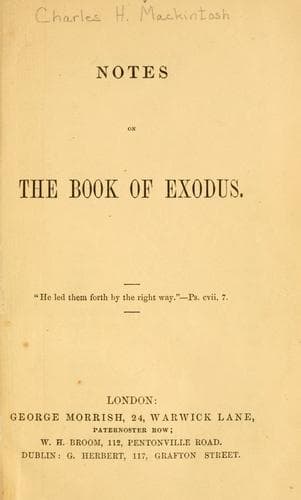
Notes on the book of ExodusMackintosh, Charles Henry
Religion
Notes on the book of Exodus
Mackintosh, Charles Henry
Bible. Exodus -- Commentaries
Pharaoh and Amalek represent two different powers or influences.
Pharaoh represents the hindrance to Israel's deliverance from Egypt:
Amalek represents the hindrance to their walk with God through the
wilderness. Pharaoh used the things of Egypt to keep Israel from
serving the Lord; he therefore prefigures Satan, who uses "this
present evil world" against the people of God: Amalek, on the other
hand, stands before us as the type of the flesh. He was the grandson
of Esau, who preferred a mess of pottage to the birthright. (See Gen.
xxxvi. 12.) He was the first who opposed Israel after their baptism
"in the cloud and in the sea." These facts serve to fix his character
with great distinctness; and, in addition to these, we know that Saul
was set aside from the kingdom of Israel in consequence of his failing
to destroy Amalek. (1 Sam. xv.) And further, we find that Haman is the
last of the Amalekites of whom we find any notice in Scripture. He was
hanged on a gallows in consequence of his wicked attempt against the
seed of Israel. (See Esther.) No Amalekite could obtain entrance into
the congregation of the Lord. And finally, in the chapter now before
us, the Lord declares perpetual war with Amalek.
All these circumstances may be regarded as furnishing conclusive
evidence of the fact that Amalek is a type of the flesh. The
connection between his conflict with Israel and the water flowing out
of the rock is most marked and instructive, and in full keeping with
the believer's conflict with his evil nature, which conflict is, as we
know, consequent upon his having the new nature, and the Holy Ghost
dwelling therein. Israel's conflict began when they stood in the full
power of redemption, and had tasted "that spiritual meat, and drunk of
that spiritual Rock." Until they met Amalek, they had nothing to do.
They did not cope with Pharaoh; they did not break the power of Egypt,
nor snap asunder the chains of its thraldom; they did not divide the
sea, nor submerge Pharaoh's hosts beneath its waves; they did not
bring down bread from heaven, nor draw forth water out of the flinty
rock;--they neither had done, nor could they do, any of these things;
but now they are called to fight with Amalek. All the previous
conflict had been between Jehovah and the enemy. They had but to
"stand still" and gaze upon the mighty triumphs of Jehovah's
outstretched arm, and enjoy the fruits of victory. The Lord had fought
_for_ them; but now He fights _in_ or _by_ them.
Public-domain text, read in full here on John Shaqi.
Reviews
Reviews
No reviews yet
Be the first to share your thoughts on this work.
Elsewhere in the archive
Join the Discussion
Join the discussion
Sign in to leave a comment or review.
Sign InorCreate an account