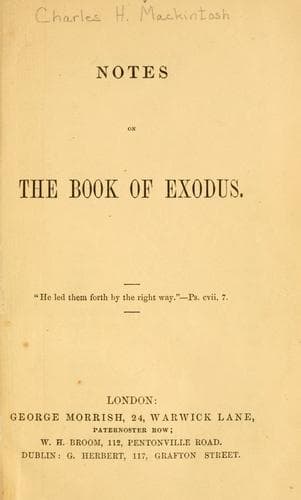
Notes on the book of ExodusMackintosh, Charles Henry
Religion
Notes on the book of Exodus
Mackintosh, Charles Henry
Bible. Exodus -- Commentaries
Thus we have, in the opening of our chapter, a millennial scene. All
the fields of glory lie open in vision before us. "_The Jew_" stands
forth as the great earthly witness of Jehovah's faithfulness, His
mercy, and His power. This is what the Jew has been in bygone ages, it
is what he is now, and what he will be, world without end. "The
Gentile" reads, in the book of God's dealings with the Jew, his
deepest lessons. He traces the marvelous history of that peculiar and
elect people--"a people terrible from their beginning hitherto;" he
sees thrones and empires overturned, nations shaken to their centre,
every one and every thing compelled to give way, in order to establish
the supremacy of that people on whom Jehovah has set His love. "Now I
know," he says, "that the Lord is greater than all gods; for in the
thing wherein they dealt proudly He was above them." (Ver. 11.) Such
is the confession of "the Gentile" when the wondrous page of Jewish
history lies open before him.
Lastly, "_the Church of God_" collectively, as prefigured by Zipporah,
and the members thereof individually, as seen in Zipporah's sons, are
presented as occupying the most intimate relationship with the
deliverer. All this is perfect in its way. We may be asked for our
proofs. The answer is, "I speak as unto wise men: judge ye what I
say." We can never build a doctrine upon a type; but when a doctrine
is revealed, a type thereof may be discerned with accuracy and studied
with profit. In every case, a spiritual mind is essentially necessary,
either to understand the doctrine or discern the type. "The natural
man receiveth not the things of the Spirit of God; for they are
foolishness unto him; neither can he know them, because they are
spiritually discerned." (1 Cor. ii. 14.)
From verse 13 to the end of our chapter, we have the appointment of
rulers, who were to assist Moses in the management of the affairs of
the congregation. This was the suggestion of Jethro, who feared that
Moses would "wear away" in consequence of his labors. In connection
with this, it may be profitable to look at the appointment of the
seventy elders in Numbers xi. Here we find the spirit of Moses crushed
beneath the ponderous responsibility which devolved upon him, and he
gives utterance to the anguish of his heart in the following accents:
"And Moses said unto the Lord, 'Wherefore hast Thou afflicted Thy
servant? And wherefore have I not found favor in Thy sight, that Thou
layest the burden of all this people upon me? Have I conceived all
this people? have I begotten them, that Thou shouldest say unto me,
Carry them in thy bosom, as a nursing father beareth the suckling
child, unto the land which Thou swarest unto their fathers?... I am
not able to bear all this people alone, because it is too heavy for
me. And if Thou deal thus with me, kill me, I pray Thee, out of hand,
if I have found favor in Thy sight; and let me not see my
wretchedness." (Numb. xi. 11-15.)
Public-domain text, read in full here on John Shaqi.
Reviews
Reviews
No reviews yet
Be the first to share your thoughts on this work.
Elsewhere in the archive
Join the Discussion
Join the discussion
Sign in to leave a comment or review.
Sign InorCreate an account