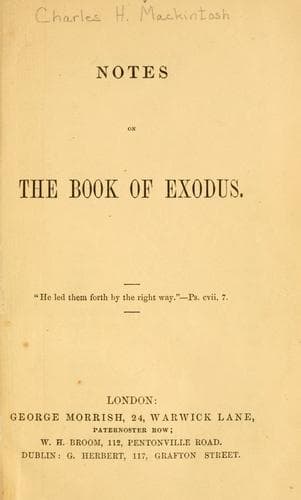
Notes on the book of ExodusMackintosh, Charles Henry
Religion
Notes on the book of Exodus
Mackintosh, Charles Henry
Bible. Exodus -- Commentaries
However, Israel was not disposed to occupy this blessed position.
Instead of rejoicing in God's "holy promise," they undertook to make
the most presumptuous vow that moral lips could utter. "All the people
answered together, and said, '_All that the Lord hath spoken, we will
do_.'" (Chap. xix. 8.) This was bold language. They did not even say,
We hope to do, or We will endeavor to do. This would have expressed a
measure of self-distrust. But no; they took the most absolute
ground.--"We will do." Nor was this the language of a few vain
self-confident spirits who presumed to single themselves out from the
whole congregation. No; "_all_ the people answered _together_." They
were unanimous in the abandonment of the "holy promise"--the "holy
covenant."
And now, observe the result. The moment Israel uttered their "singular
vow," the moment they undertook to "do," there was a total alteration
in the aspect of things. "And the Lord said unto Moses, 'Lo, I come
unto thee _in a thick cloud_.... And thou shalt set bounds unto the
people, round about, saying, Take heed to yourselves, that ye go not
up into the mount, or touch the border of it: whosoever toucheth the
mount shall be surely put to death.'" This was a very marked change.
The One who had just said, "I bare you on eagles' wings, and brought
you unto Myself," now envelopes Himself "in a thick cloud," and says,
"Set bounds unto the people, round about." The sweet accents of grace
and mercy are exchanged for the "thunderings and lightnings" of the
fiery mount. Man had presumed to talk of his miserable doings in the
presence of God's magnificent grace. Israel had said, "We will do,"
and they must be put at a distance in order that it may be fully seen
what they are able to do. God takes the place of moral distance; and
the people are but too well disposed to have it so, for they are
filled with fear and trembling; and no marvel, for the sight was
"terrible,"--"so terrible, that Moses said, 'I exceedingly fear and
quake.'" Who could endure the sight of that "devouring fire," which
was the apt expression of divine holiness? "The Lord came from Sinai,
and rose up from Seir unto them; He shined forth from Paran, and He
came with ten thousand of His saints; from His right hand went a fiery
law for them." (Deut. xxxiii. 2.) The term "fiery," as applied to the
law, is expressive of its holiness,--"Our God is a consuming
fire"--perfectly intolerant of evil, in thought, word, and deed.
Public-domain text, read in full here on John Shaqi.
Reviews
Reviews
No reviews yet
Be the first to share your thoughts on this work.
Elsewhere in the archive
Join the Discussion
Join the discussion
Sign in to leave a comment or review.
Sign InorCreate an account