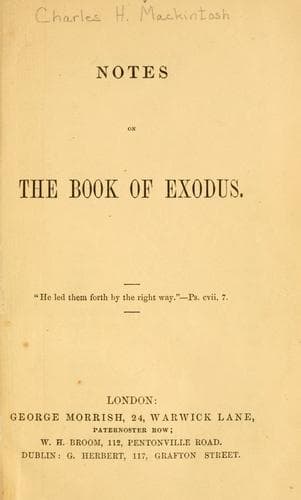
Notes on the book of ExodusMackintosh, Charles Henry
Religion
Notes on the book of Exodus
Mackintosh, Charles Henry
Bible. Exodus -- Commentaries
But that I may not weary the reader with arguments, let me ask, If the
law be indeed the rule of a believer's life, where are we to find it
so presented in the New Testament? The inspired apostle evidently had
no thought of its being the rule when he penned the following words:
"For in Christ Jesus neither circumcision availeth any thing nor
uncircumcision, but a new creation. And as many as walk according to
_this rule_, peace be on them, and mercy, and on the Israel of God."
(Gal. vi. 15, 16.) What "rule"? The law? No; but the "new creation."
Where shall we find this in Exodus xx? It speaks not a word about "new
creation." On the contrary, it addresses itself to man as he is--in
his natural or old-creation state--and puts him to the test as to what
he is really able to do. Now if the law were the rule by which
believers are to walk, why does the apostle pronounce his benediction
on those who walk by another rule altogether? Why does he not say, As
many as walk according to the rule of the ten commandments? Is it not
evident, from this one passage, that the Church of God has a higher
rule by which to walk? Unquestionably. The ten commandments, though
forming, as all true Christians admit, a part of the canon of
inspiration, could never be the rule of life to one who has, through
infinite grace, been introduced into the new creation--one who has
received new life in Christ.
But some may ask, Is not the law perfect? and if perfect, what more
would you have? The law is divinely perfect. Yea, it is the very
perfection of the law which causes it to curse and slay those who are
not perfect if they attempt to stand before it. "The law is spiritual,
but I am carnal." It is utterly impossible to form an adequate idea of
the infinite perfectness and spirituality of the law. But then this
perfect law coming in contact with fallen humanity--this spiritual law
coming in contact with "the carnal mind," could only "work wrath" and
"enmity." (Rom. iv. 15; viii. 7.) Why? Is it because the law is not
perfect? No, but because it is, and man is a sinner. If man were
perfect, he would carry out the law in all its spiritual perfectness;
and even in the case of true believers, though they still carry about
with them an evil nature, the apostle teaches us "that the
righteousness of the law is fulfilled in us, who walk not after the
flesh, but after the Spirit." (Rom. viii. 4.) "He that loveth another
hath fulfilled the law.... Love worketh no ill to his neighbor;
therefore love is the fulfilling of the law." (Rom. xiii. 8-10.) If I
love a man, I shall not steal his property--nay, I shall seek to do
him all the good I can. All this is plain, and easily understood by
the spiritual mind; but it leaves entirely untouched the question of
the law, whether as the ground of life to a sinner or the rule of life
to the believer.
Public-domain text, read in full here on John Shaqi.
Reviews
Reviews
No reviews yet
Be the first to share your thoughts on this work.
Elsewhere in the archive
Join the Discussion
Join the discussion
Sign in to leave a comment or review.
Sign InorCreate an account