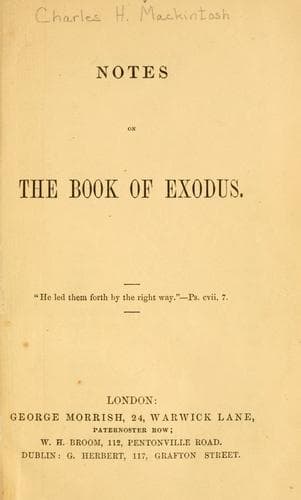
Notes on the book of ExodusMackintosh, Charles Henry
Religion
Notes on the book of Exodus
Mackintosh, Charles Henry
Bible. Exodus -- Commentaries
This chapter opens with an expression remarkably characteristic of the
entire Mosaic economy. "And He said unto Moses, 'Come up unto the
Lord, thou, and Aaron, Nadab, and Abihu, and seventy of the elders of
Israel; and worship ye _afar off ... they shall not come nigh_,
neither shall the people _go up_ with him." We may search from end to
end of the legal ritual, and not find those two precious words, "_draw
nigh_." Ah, no; such words could never be heard from the top of Sinai,
nor from amid the shadows of the law. They could only be uttered at
heaven's side of the empty tomb of Jesus, where the blood of the cross
has opened a perfectly cloudless prospect to the vision of faith. The
words, "afar off," are as characteristic of the law as "draw nigh" are
of the gospel. Under the law, the work was never done which could
entitle a sinner to draw nigh. Man had not fulfilled his promised
obedience; and the "blood of calves and goats" could not atone for the
failure, or give his guilty conscience peace. Hence, therefore, he had
to stand "afar off." Man's vows were broken and his sin unpurged; how,
then, could he draw nigh? The blood of ten thousand bullocks could not
wipe away one stain from the conscience, or give the peaceful sense of
nearness as being reconciled to God.
However, the "first covenant" is here dedicated with blood. An altar
is erected at the foot of the hill, with "twelve pillars, according to
the twelve tribes of Israel." "And he sent young men of the children
of Israel, which offered burnt-offerings, and sacrificed
peace-offerings of oxen unto the Lord. And Moses took half of the
blood, and put it in basins; and half of the blood he sprinkled on
the altar.... And Moses took the blood, and sprinkled it on the
people, and said, 'Behold the blood of the covenant, which the Lord
hath made with you concerning all these words.'" Although, as the
apostle teaches us, it was "impossible that the blood of bulls and
goats could take away sin," yet did it "sanctify to the purifying of
the flesh," and, as "a shadow of good things to come," it availed to
maintain the people in relationship with Jehovah.
Public-domain text, read in full here on John Shaqi.
Reviews
Reviews
No reviews yet
Be the first to share your thoughts on this work.
Elsewhere in the archive
Join the Discussion
Join the discussion
Sign in to leave a comment or review.
Sign InorCreate an account