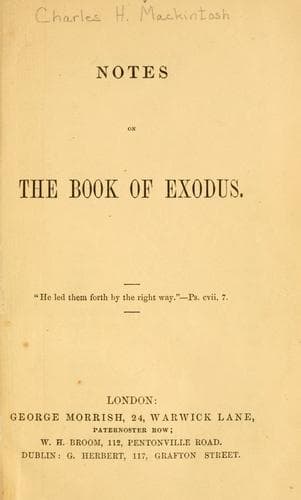
Notes on the book of ExodusMackintosh, Charles Henry
Religion
Notes on the book of Exodus
Mackintosh, Charles Henry
Bible. Exodus -- Commentaries
Here Jehovah gives utterance to His gracious intention of coming down
from the fiery mount to take His place upon the mercy-seat. This He
could do, inasmuch as the tables of testimony were preserved unbroken
beneath, and the symbols of His power, whether in creation or
providence, rose on the right hand and on the left--the inseparable
adjuncts of that throne on which Jehovah had seated Himself--a throne
of grace founded upon divine righteousness and supported by justice
and judgment. Here the glory of the God of Israel shone forth. From
hence He issued His commands, softened and sweetened by the gracious
source from whence they emanated, and the medium through which they
came--like the beams of the mid-day sun, passing through a cloud, we
can enjoy their genial and enlivening influence without being dazzled
by their brightness. "His commandments are not grievous," when
received from off the mercy-seat, because they come in connection with
grace, which gives the ears to hear and the power to obey.
Looking at the ark and mercy-seat together, we may see in them a
striking figure of Christ in His Person and work. He having, in His
life, magnified the law and made it honorable, became, through death,
a propitiation (or mercy-seat) for every one that believeth. God's
mercy could only repose on a pedestal of perfect righteousness. "Grace
reigns through righteousness unto eternal life by Jesus Christ our
Lord." (Rom. v. 21.) The only proper meeting-place between God and man
is the point where grace and righteousness meet and perfectly
harmonize. Nothing but perfect righteousness could suit God, and
nothing but perfect grace could suit the sinner. But where could these
attributes meet in one point? Only in the cross. There it is that
"mercy and truth are met together; righteousness and peace have kissed
each other." (Ps. lxxxv. 10.) Thus it is that the soul of the
believing sinner finds peace. He sees that God's righteousness and his
justification rest upon precisely the same basis, namely, Christ's
accomplished work. When man, under the powerful action of _the truth_
of God, takes his place as a sinner, God can, in the exercise of
_grace_, take His place as a Saviour, and then every question is
settled, for the cross having answered all the claims of divine
justice, mercy's copious streams can flow unhindered. When a righteous
God and a ruined sinner meet on a blood-sprinkled platform, all is
settled forever--settled in such a way as perfectly glorifies God, and
eternally saves the sinner. God must be true, though every man be
proved a liar; and when man is so thoroughly brought down to the
lowest point of his own moral condition before God as to be willing to
take the place which God's truth assigns him, he then learns that God
has revealed Himself as the righteous Justifier of such an one. This
must give settled peace to the conscience; and not only so, but impart
a capacity to commune with God, and hearken to His holy precepts, in
Public-domain text, read in full here on John Shaqi.
Reviews
Reviews
No reviews yet
Be the first to share your thoughts on this work.
Elsewhere in the archive
Join the Discussion
Join the discussion
Sign in to leave a comment or review.
Sign InorCreate an account