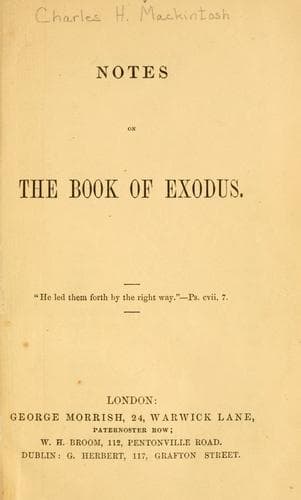
Notes on the book of ExodusMackintosh, Charles Henry
Religion
Notes on the book of Exodus
Mackintosh, Charles Henry
Bible. Exodus -- Commentaries
But while this is a plainly revealed truth of Scripture, it is equally
plain that incarnation formed, as it were, the first layer of the
glorious superstructure; and the curtains of "fine twined linen"
prefigure the moral purity of "the Man Christ Jesus." We have already
seen the manner of His conception; and, as we pass along the current
of His life here below, we meet with instance after instance of the
same spotless purity. He was forty days in the wilderness, tempted of
the devil, but there was no response in His pure nature to the
tempters foul suggestions. He could touch the leper and receive no
taint; He could touch the bier and not contract the smell of death; He
could pass unscathed through the most polluted atmosphere. He was, as
to His manhood, like a sunbeam emanating from the fountain of light,
which can pass without a soil through the most defiling medium. He was
perfectly unique in nature, constitution, and character. None but He
could say, "Thou wilt not suffer Thine holy One to see corruption."
This was in reference to His humanity, which, as being perfectly holy
and perfectly pure, was capable of being a sin-bearer. "His own self
bare our sins in His own body on the tree." Not _to_ the tree, as some
would teach us; but "_on_ the tree." It was on the cross that Christ
was our sin-bearer, and only there. "He hath made Him to be sin for us
who knew no sin, that we might be made the righteousness of God in
Him." (2 Cor. v. 21.)
"_Blue_" is the ethereal color, and marks the heavenly character of
Christ, who, though He had come down into all the circumstances of
actual and true humanity (sin excepted), yet was He "the Lord from
heaven." Though He was "very man," yet He ever walked in the
uninterrupted consciousness of His proper dignity, as a heavenly
stranger. He never once forgot whence He had come, where He was, or
whither He was going. The spring of all His joys was on high. Earth
could neither make Him richer nor poorer. He found this world to be "a
dry and thirsty land, where no water is," and hence His spirit could
only find its refreshment above. It was entirely heavenly.--"No man
hath ascended up to heaven, but He that came down from heaven, even
the Son of Man _who is in heaven_." (John iii. 13.)
Public-domain text, read in full here on John Shaqi.
Reviews
Reviews
No reviews yet
Be the first to share your thoughts on this work.
Elsewhere in the archive
Join the Discussion
Join the discussion
Sign in to leave a comment or review.
Sign InorCreate an account