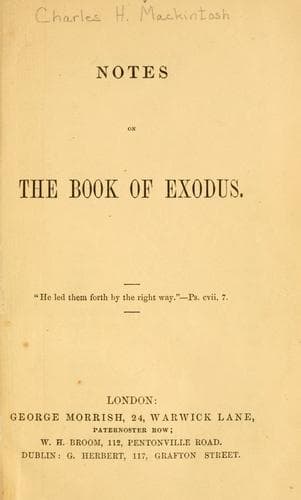
Notes on the book of ExodusMackintosh, Charles Henry
Religion
Notes on the book of Exodus
Mackintosh, Charles Henry
Bible. Exodus -- Commentaries
This altar was the place where the sinner approached God, in the power
and efficacy of the blood of atonement. It stood "at the door of the
tabernacle of the tent of the congregation," and on it all the blood
was shed. It was composed of "shittim wood and brass." The wood was
the same as that of the golden altar of incense: but the metal was
different, and the reason of this difference is obvious. The altar of
brass was the place where sin was dealt with according to the divine
judgment concerning it. The altar of gold was the place from whence
the precious fragrance of Christ's acceptableness ascended to the
throne of God. The "shittim wood," as the figure of Christ's humanity,
must be the same in each case; but in the brazen altar we see Christ
meeting the fire of divine justice; in the golden altar we behold Him
feeding the divine affections. At the former, the fire of divine wrath
was quenched; at the latter, the fire of priestly worship is kindled.
The soul delights to find Christ in both; but the altar of brass is
what meets the need of a guilty conscience,--it is the very first
thing for a poor, helpless, needy, convicted sinner. There cannot be
settled peace, in reference to the question of sin, until the eye of
faith rests on Christ as the antitype of the brazen altar. I must see
my sin reduced to ashes in the pan of that altar ere I can enjoy rest
of conscience in the presence of God. It is when I know, by faith in
the record of God, that He Himself has dealt with my sin in the Person
of Christ, at the brazen altar--that He has satisfied all His own
righteous claims--that He has put away my sin out of His holy
presence, so that it can never come back again--it is then, but not
until then, that I can enjoy divine and everlasting peace.
I would here offer a remark as to the real meaning of the "gold" and
"brass" in the furniture of the tabernacle. "Gold" is the symbol of
divine righteousness, or the divine nature in "the Man Christ Jesus."
"Brass" is the symbol of righteousness, demanding judgment of sin, as
in the brazen altar; or the judgment of uncleanness, as in the brazen
laver. This will account for the fact that _inside_ the tent of the
tabernacle all was gold,--the ark, the mercy-seat, the table, the
candlestick, the altar of incense. All these were the symbols of the
divine nature--the inherent personal excellence of the Lord Jesus
Christ. On the other hand, _outside_ the tent of the tabernacle all
was brass,--the brazen altar and its vessels, the laver and its foot.
The claims of righteousness, as to sin and uncleanness, must be
divinely met ere there can be any enjoyment of the precious mysteries
of Christ's Person, as unfolded in the inner sanctuary of God. It is
when I see all sin and all uncleanness perfectly judged and washed
away that I can, as a priest, draw nigh and worship in the holy place,
and enjoy the full display of all the beauty and excellency of the
God-man, Christ Jesus.
Public-domain text, read in full here on John Shaqi.
Reviews
Reviews
No reviews yet
Be the first to share your thoughts on this work.
Elsewhere in the archive
Join the Discussion
Join the discussion
Sign in to leave a comment or review.
Sign InorCreate an account