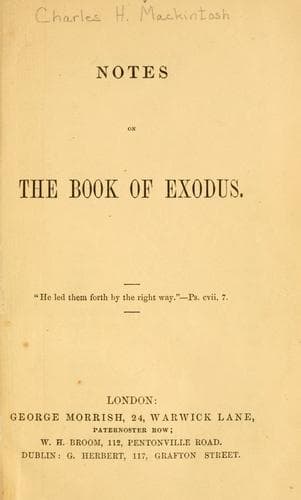
Notes on the book of ExodusMackintosh, Charles Henry
Religion
Notes on the book of Exodus
Mackintosh, Charles Henry
Bible. Exodus -- Commentaries
But there is yet one point connected with Aaron's robes which demands
the reader's special attention, and that is the mode in which the gold
was introduced in the making of them. This is presented to us in
chapter xxxix, but the interpretation comes in suitably enough in this
place. "And they did beat the gold into thin plates, and cut it into
wires, to work it in the blue, and in the purple, and in the scarlet,
and in the fine linen, with cunning work." (Ver. 3.) We have already
remarked that "the blue, the purple, the scarlet, and fine twined
linen" exhibit the various phases of Christ's manhood, and the gold
represents his divine nature. The wire of gold was curiously
insinuated into all the other materials, so as to be inseparably
connected with, and yet perfectly distinct from, them.
The application of this striking figure to the character of the Lord
Jesus is full of interest. In various scenes throughout the gospel
narrative, we can easily discern this rare and beauteous union of
manhood and Godhead, and, at the same time, their mysterious
distinctness.
Look, for example, at Christ on the sea of Galilee. In the midst of
the storm "He was asleep on a pillow" (precious exhibition of His
perfect manhood!); but in a moment He rises from the attitude of real
humanity into all the dignity and majesty of Godhead, and, as the
supreme Governor of the universe, He hushes the storm and calms the
sea. There is no effort, no haste, no girding Himself up for an
occasion. With perfect ease, He rises from the condition of positive
humanity into the sphere of essential deity. The repose of the former
is not more natural than the activity of the latter. He is as
perfectly at home in the one as in the other.
Again, see Him in the case of the collectors of tribute, at the close
of Matthew xvii. As the "Most High God, possessor of heaven and
earth," He lays His hand upon the treasures of the ocean, and says,
"They are Mine;" and, having declared that "the sea is His, and He
made it," He turns round and, in the exhibition of perfect humanity,
He links Himself with His poor servant by those touching words, "That
take, and give unto them _for Me and thee_." Gracious words!--peculiarly
gracious, when taken in connection with the miracle so entirely
expressive of the Godhead of the One who was thus linking Himself, in
infinite condescension, with a poor, feeble worm.
Once more, see Him at the grave of Lazarus. (John xi.) He groans and
weeps, and those groans and tears issue from the profound depths of a
perfect manhood--from that perfect human heart which felt, as no other
heart could feel, what it was to stand in the midst of a scene in
which sin had produced such terrible fruits. But then, as the
Resurrection and the Life, as the One who held in His omnipotent grasp
"the keys of hell and of death," He cries, "Lazarus, come forth!" and
death and the grave, responsive to His authoritative voice, throw
open their massy doors and let go their captive.
Public-domain text, read in full here on John Shaqi.
Reviews
Reviews
No reviews yet
Be the first to share your thoughts on this work.
Elsewhere in the archive
Join the Discussion
Join the discussion
Sign in to leave a comment or review.
Sign InorCreate an account