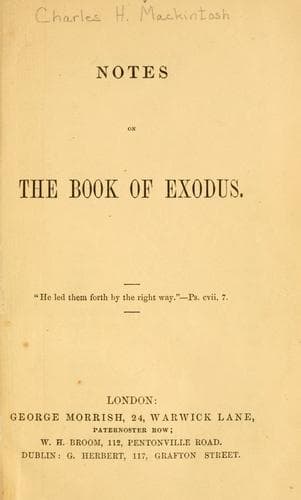
Notes on the book of ExodusMackintosh, Charles Henry
Religion
Notes on the book of Exodus
Mackintosh, Charles Henry
Bible. Exodus -- Commentaries
This altar typifies a position of wondrous blessedness. There we enjoy
the reality and efficacy of Christ's intercession. Forever done with
self and all pertaining thereto, so far as any expectation of good is
concerned, we are to be occupied with what He is before God. We shall
find nothing in self but defilement. Every exhibition of it is
defiling; it has been condemned and set aside in the judgment of God,
and not a shred or particle thereof is to be found in the pure incense
and pure fire, on the altar of pure gold: it could not be. We have
been introduced, "by the blood of Jesus," into the sanctuary--a
sanctuary of priestly service and worship, in which there is not so
much as a trace of sin. We see the pure table, the pure candlestick,
and the pure altar; but there is nothing to remind us of self and its
wretchedness. Were it possible for aught of that to meet our view, it
could but prove the death-knell of our worship, mar our priestly food,
and dim our light. Nature can have no place in the sanctuary of God.
It, together with all its belongings, has been consumed to ashes; and
we are now to have before our souls the fragrant odor of Christ,
ascending in grateful incense to God: this is what God delights in.
Every thing that presents Christ in His own proper excellence is sweet
and acceptable to God. Even the feeblest expression or exhibition of
Him, in the life or worship of a saint, is an odor of a sweet smell in
which God is well pleased.
Too often, alas! we have to be occupied with our failures and
infirmities. If ever the workings of indwelling sin be suffered to
rise to the surface, we must deal with our God about them, for He
cannot go on with sin. He can forgive it, and cleanse us from it; He
can restore our souls by the gracious ministry of our great
High-Priest; but He cannot go on in company with a single sinful
thought. A light or foolish thought, as well as an unclean or covetous
one, is amply sufficient to mar a Christian's communion, and interrupt
his worship. Should any such thought spring up, it must be judged and
confessed, ere the elevated joys of the sanctuary can be known afresh.
A heart in which lust is working is not enjoying the proper
occupations of the sanctuary. When we are in our proper priestly
condition, nature is as though it had no existence; then we can feed
upon Christ: we can taste the divine luxury of being wholly at leisure
from ourselves, and wholly engrossed with Christ.
All this can only be produced by the power of the Spirit. There is no
need of seeking to work up nature's devotional feelings, by the
various appliances of systematic religion; there must be pure fire as
well as pure incense. (Comp. Lev. x. 1, with xvi. 12.) All efforts at
worshiping God by the unhallowed powers of nature come under the head
of "strange fire." God is the object of worship; Christ the ground
and the material of worship; and the Holy Ghost the power of worship.
Public-domain text, read in full here on John Shaqi.
Reviews
Reviews
No reviews yet
Be the first to share your thoughts on this work.
Elsewhere in the archive
Join the Discussion
Join the discussion
Sign in to leave a comment or review.
Sign InorCreate an account