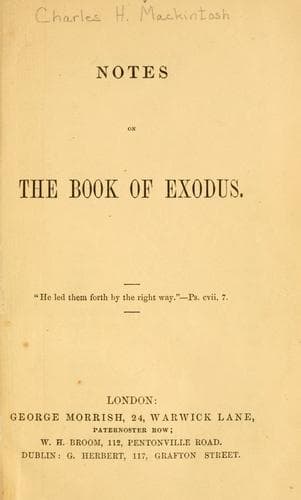
Notes on the book of ExodusMackintosh, Charles Henry
Religion
Notes on the book of Exodus
Mackintosh, Charles Henry
Bible. Exodus -- Commentaries
"And the children of Israel stripped themselves of their ornaments by
the mount Horeb." There they stood, beneath that memorable mount,
their feasting and singing changed into bitter lamentations, their
ornaments gone, the tables of testimony in fragments. Such was their
condition, and Moses at once proceeds to act according to it. He could
no longer own the people in their corporate character. The assembly
had become entirely defiled, having set up an idol of their own making
in the place of God--a calf instead of Jehovah. "And Moses took the
tabernacle, and pitched it _without the camp_, afar off from the camp,
and called it 'The tabernacle of the congregation.'" Thus the camp was
disowned as the place of the divine presence. God was not, could not,
be there. He had been displaced by a human invention. A new
gathering-point was therefore set up. "And it came to pass, that every
one which sought the Lord went out unto the tabernacle of the
congregation, which was without the camp."
There is here a fine principle of truth, which the spiritual mind will
readily apprehend. The place which Christ now occupies is "without the
camp," and we are called upon to "go forth unto Him." It demands much
subjection to the Word to be able, with accuracy, to know what "the
camp" really is, and much spiritual power to be able to go forth from
it: and still more to be able, while "far off from it," to act
towards those in it in the combined power of holiness and
grace;--holiness, which separates from the defilement of the camp;
grace, which enables us to act toward those who are involved therein.
"And the Lord spake unto Moses face to face, as a man speaketh unto
his friend. And he turned again into the camp; but his servant Joshua,
the son of Nun, a young man, departed not out of the tabernacle."
Moses exhibits a higher degree of spiritual energy than his servant
Joshua. It is much easier to assume a position of separation from the
camp than to act aright towards those within.
"And Moses said unto the Lord, 'See, Thou sayest unto me. Bring up
this people; and Thou hast not let me know whom Thou wilt send with
me; yet Thou hast said, I know thee by name, and thou hast also found
grace in My sight.'" Moses entreats the accompanying presence of
Jehovah, as a proof of their having found _grace_ in His sight. Were
it a question of mere _justice_, He could only consume them by coming
in their midst, because they were "a stiff-necked people;" but
directly He speaks of grace, in connection with the mediator, the very
stiff-neckedness of the people is made a plea for demanding His
presence.--"If now I have found grace in Thy sight, O Lord, let my
Lord, I pray Thee, go among us; _for it is a stiff-necked people_; and
pardon our iniquity and our sin, and take us for Thine inheritance."
This is touchingly beautiful. A "stiff-necked people" demanded the
boundless grace and exhaustless patience of God. None but He could
bear with them.
Public-domain text, read in full here on John Shaqi.
Reviews
Reviews
No reviews yet
Be the first to share your thoughts on this work.
Elsewhere in the archive
Join the Discussion
Join the discussion
Sign in to leave a comment or review.
Sign InorCreate an account