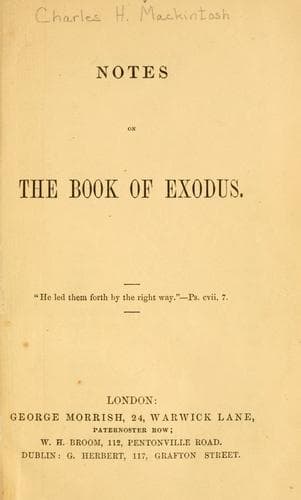
Notes on the book of ExodusMackintosh, Charles Henry
Religion
Notes on the book of Exodus
Mackintosh, Charles Henry
Bible. Exodus -- Commentaries
A lovely picture this of devotedness to the work of the sanctuary! It
needed no effort to move the hearts of the people to give, no earnest
appeals, no impressive arguments. Oh, no! their "_hearts_ stirred
them up." This was the true way. The streams of voluntary devotedness
flowed from within. "Rulers," "men," "women,"--all felt it to be their
sweet privilege to give to the Lord, not with a narrow heart or
niggard hand, but after such a princely fashion that they had
"_enough, and too much_."
Then, as to _their implicit obedience_, we read, "_According to all
that the Lord commanded Moses_, so the children of Israel made all the
work. And Moses did look upon all the work, and, behold, _they had
done it as the Lord had commanded, even so had they done it_: and
Moses blessed them." (Chap. xxxix. 42, 43.) The Lord had given the
most minute instructions concerning the entire work of the tabernacle.
Every pin, every socket, every loop, every tach, was accurately set
forth. There was no room left for man's expediency, his reason, or his
common sense. Jehovah did not give a great outline and leave man to
fill it up. He left no margin whatever in which man might enter his
regulations. By no means. "'See,' saith He, 'that thou make _all
things according to the pattern showed to thee in the mount_.'" (Exod.
xxv. 40; xxvi. 30; Heb. viii. 5.) This left no room for human device.
If man had been allowed to make a single pin, that pin would most
assuredly have been out of place in the judgment of God. We can see
what man's "graving tool" produces in chapter xxxii. Thank God, it had
no place in the tabernacle. They did, in this matter, just what they
were told--nothing more, nothing less. Salutary lesson this for the
professing church! There are many things in the history of Israel
which we should earnestly seek to avoid,--their impatient murmurings,
their legal vows, and their idolatry; but in those two things may we
imitate them. May our devotedness be more whole-hearted, and our
obedience more implicit! We may safely assert that if all had not been
done "according to the pattern showed in the mount," we should not
have to read, "then a cloud covered the tent of the congregation, and
the glory of the Lord filled the tabernacle. And Moses was not able to
enter into the tent of the congregation, because the cloud abode
thereon, and the glory of the Lord filled the tabernacle." (Chap. xl.
34, 35.) The tabernacle was in all respects according to _the divine
pattern_, and therefore it could be filled with _the divine glory_.
Public-domain text, read in full here on John Shaqi.
Reviews
Reviews
No reviews yet
Be the first to share your thoughts on this work.
Elsewhere in the archive
Join the Discussion
Join the discussion
Sign in to leave a comment or review.
Sign InorCreate an account