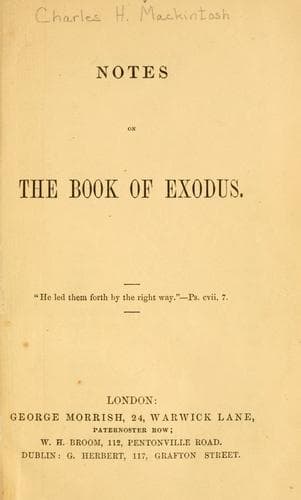
Notes on the book of ExodusMackintosh, Charles Henry
Religion
Notes on the book of Exodus
Mackintosh, Charles Henry
Bible. Exodus -- Commentaries
And mark, it is "that they may hold a feast to _Me_." If they were to
get done with Pharaoh, it was that they might begin with God. This was
a great change. Instead of toiling under Pharaoh's taskmasters, they
were to feast in company with Jehovah; and, although they were to pass
from Egypt into the wilderness, still the divine presence was to
accompany them; and if the wilderness was rough and dreary, it was the
way to the land of Canaan. The divine purpose was, that they should
hold a feast unto the Lord in the wilderness, and in order to do this,
they should be "_let go_" out of Egypt.
However, Pharaoh was in no wise disposed to yield obedience to the
divine mandate. "Who is the Lord," said he, "that I should obey His
voice to let Israel go? I know not the Lord, neither will I let Israel
go." (Chap. v. 2.) Pharaoh most truly expressed, in these words, his
real condition. His condition was one of ignorance and consequent
disobedience. Both go together. If God be not known, He cannot be
obeyed; for obedience is ever founded upon knowledge. When the soul is
blessed with the knowledge of God, it finds this knowledge to be life
(John xvii. 3.), and life is power; and when I get power, I can act.
It is obvious that one cannot act without life; and therefore it is
most unintelligent to set people upon doing certain things in order to
get that by which alone they can do anything.
But Pharaoh was as ignorant of himself as he was of the Lord. He did
not know that he was a poor, vile worm of the earth, and that he had
been raised up for the express purpose of making known the glory of
the very One whom he said he knew not. (Exod. ix. 16; Rom. ix. 17.)
"And they said, 'The God of the Hebrews has met with us: let us go, we
pray thee, three days' journey into the desert, and sacrifice unto the
Lord our God; lest He fall upon us with pestilence or with the sword.'
And the king of Egypt said unto them, 'Wherefore do ye, Moses and
Aaron, let the people from their work? Get you unto your burdens ...
let there more work be laid upon the men, that they may labor therein;
and let them not regard _vain words_.'" (Ver. 3-9.)
What a development of the secret springs of the human heart we have
here! What complete incompetency to enter into the things of God! All
the divine titles and the divine revelations were, in Pharaoh's
estimation, "vain words." What did he know or care about "three days'
journey into the wilderness," or "a feast to Jehovah"? How could he
understand the need of such a journey, or the nature or object of such
a feast? Impossible. He could understand burden-bearing and
brick-making; these things had an air of reality about them, in his
judgment; but as to aught of God, His service, or His worship, he
could only regard it in the light of an idle chimera, devised by those
who only wanted an excuse to make their escape from the stern
realities of actual life.
Public-domain text, read in full here on John Shaqi.
Reviews
Reviews
No reviews yet
Be the first to share your thoughts on this work.
Join the Discussion
Join the discussion
Sign in to leave a comment or review.
Sign InorCreate an account