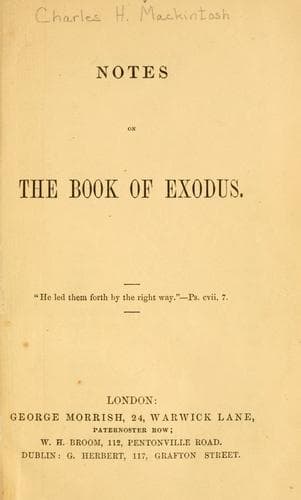
Notes on the book of ExodusMackintosh, Charles Henry
Religion
Notes on the book of Exodus
Mackintosh, Charles Henry
Bible. Exodus -- Commentaries
Thus has it too often been with the wise and great of this world. They
have ever been the most forward to write folly and vanity upon the
divine testimonies. Hearken, for example, to the estimate which the
"most noble Festus" formed of the grand question at issue between Paul
and the Jews:--"They had certain questions against him of their own
superstition, and _of one Jesus, which was dead, whom Paul affirmed to
be alive_." (Acts xxv. 19.) Alas! how little he knew what he was
saying! How little he knew what was involved in the question, as to
whether "Jesus" was "dead" or "alive"! He thought not of the solemn
bearing of that momentous question upon himself and his friends,
Agrippa and Bernice; but that did not alter the matter; he and they
know somewhat more about it now, though in their passing moment of
earthly glory they regarded it as a superstitious question, wholly
beneath the notice of men of common sense, and only fit to occupy the
disordered brain of visionary enthusiasts. Yes; the stupendous
question which fixes the destiny of every child of Adam--on which is
founded the present and everlasting condition of the Church and the
world--which stands connected with all the divine counsels,--this
question was, in the judgment of Festus, a vain superstition.
Thus was it in Pharaoh's case. He knew nothing of "the Lord God of the
Hebrews"--the great "I AM," and hence he regarded all that Moses and
Aaron had said to him, in reference to doing sacrifice to God, as
"vain words." The things of God must ever seem vain, profitless, and
unmeaning to the unsanctified mind of man. His name may be made use of
as part of the flippant phraseology of a cold and formal
religiousness; but He Himself is not known. His precious name, which,
to a believer's heart, has wrapped up in it all that he can possibly
need or desire, has no significancy, no power, no virtue for an
unbeliever. All, therefore, connected with God--His words, His
counsels, His thoughts, His ways,--everything, in short, that treats
of or refers to Him, is regarded as "vain words."
However, the time is rapidly approaching when it will not be thus. The
judgment-seat of Christ, the terrors of the world to come, the surges
of the lake of fire, will not be "vain words." Assuredly not; and it
should be the great aim of all who, through grace, believe them now to
be realities, to press them upon the consciences of those who, like
Pharaoh, regard the making of bricks as the only thing worth thinking
about--the only thing that can be called real and solid.
Public-domain text, read in full here on John Shaqi.
Reviews
Reviews
No reviews yet
Be the first to share your thoughts on this work.
Join the Discussion
Join the discussion
Sign in to leave a comment or review.
Sign InorCreate an account