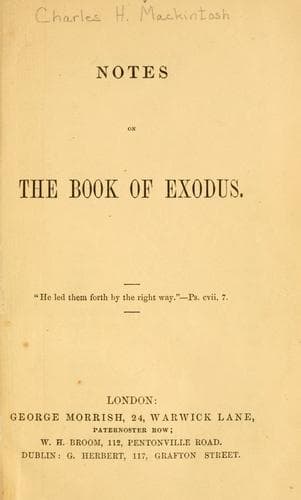
Notes on the book of ExodusMackintosh, Charles Henry
Religion
Notes on the book of Exodus
Mackintosh, Charles Henry
Bible. Exodus -- Commentaries
Alas! that even Christians should so frequently be found living in the
region of sight--the region of earth--the region of nature--as to lose
the deep, abiding, influential sense of the reality of divine and
heavenly things. We want to live more in the region of faith--the
region of heaven--the region of the "new creation." Then we should see
things as God sees them, think about them as He thinks; and our whole
course and character would be more elevated, more disinterested, more
thoroughly separated from earth and earthly things.
But Moses' sorest trial did not arise from Pharaoh's judgment about
his mission. The true and whole-hearted servant of Christ must ever
expect to be looked on, by the men of this world, as a mere visionary
enthusiast. The point of view from which they contemplate him is such
as to lead us to look for this judgment and none other. The more
faithful he is to his heavenly Master, the more he walks in His
footsteps, the more conformed he is to His image, the more likely he
is to be considered, by the sons of earth, as one "beside himself."
This, therefore, should neither disappoint nor discourage him. But
then it is a far more painful thing when his service and testimony are
misunderstood, unheeded, or rejected by those who are themselves the
specific objects thereof. When such is the case, he needs to be much
with God, much in the secret of His mind, much in the power of
communion, to have his spirit sustained in the abiding reality of his
path and service. Under such trying circumstances, if one be not fully
persuaded of the divine commission, and conscious of the divine
presence, he will be almost sure to break down.
Had not Moses been thus upheld, his heart must have utterly failed him
when the augmented pressure of Pharaoh's power elicited from the
officers of the children of Israel such desponding and depressing
words as these,--"The Lord look upon you, and judge; because ye have
made our savor to be abhorred in the eyes of Pharaoh, and in the eyes
of his servants, to put a sword in their hand to slay us." This was
gloomy enough; and Moses felt it so, for "he returned unto the Lord,
and said, 'Lord, wherefore hast Thou so evil entreated this people?
Why is it that Thou hast sent me? For since I came unto Pharaoh to
speak in Thy name, he hath done evil to this people; neither hast Thou
delivered Thy people at all.'" The aspect of things had become most
discouraging, at the very moment when deliverance seemed at hand;
just as, in nature, the darkest hour of the night is often that which
immediately precedes the dawn of the morning. Thus will it assuredly
be in Israel's history in the latter day. The moment of most profound
darkness and depressing gloom will precede the bursting of "the Sun of
Righteousness" from behind the cloud, with healing in His wings to
heal eternally "the hurt of the daughter of His people."
Public-domain text, read in full here on John Shaqi.
Reviews
Reviews
No reviews yet
Be the first to share your thoughts on this work.
Join the Discussion
Join the discussion
Sign in to leave a comment or review.
Sign InorCreate an account