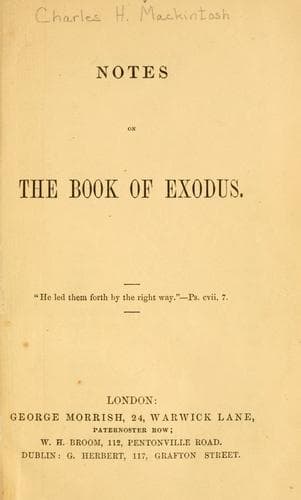
Notes on the book of ExodusMackintosh, Charles Henry
Religion
Notes on the book of Exodus
Mackintosh, Charles Henry
Bible. Exodus -- Commentaries
Reader, we should deeply ponder this. The effort to induce Israel to
worship God in Egypt reveals a far deeper principle than we might, at
first sight, imagine. The enemy would rejoice, at any time, by any
means, or under any circumstances, to get even the semblance of divine
sanction for the world's religion. He has no objections to such
religion. He gains his end as effectually by what is termed "the
religious world" as by any other agency; and hence, when he can
succeed in getting a true Christian to accredit the religion of the
day, he gains a grand point. As a matter of actual fact, one knows
that nothing elicits such intense indignation as the divine principle
of separation from this present evil world. You may hold the same
opinions, preach the same doctrines, do the same work; but if you only
attempt, in ever so feeble a manner, to act upon the divine commands,
"From such turn away" (2 Tim. iii. 5.), and "Come out from among
them" (2 Cor. vi. 17.), you may reckon assuredly upon the most
vigorous opposition. Now how is this to be accounted for? Mainly by
the fact that Christians, in separation from this world's hollow
religiousness, bear a testimony for Christ which they never can bear
while connected with it.
There is a very wide difference between human religion and Christ. A
poor, benighted Hindoo might talk to you of his religion, but he knows
nothing of Christ. The apostle does not say, If there be any
consolation in religion; though, doubtless, the votaries of each kind
of religion find what they deem consolation therein. Paul, on the
other hand, found his consolation in Christ, having fully proved the
worthlessness of religion, and that, too, in its fairest and most
imposing form. (Comp. Gal. i. 13, 14; Phil. iii. 4-11.)
True, the Spirit of God speaks to us of "pure religion and undefiled;"
but the unregenerate man cannot, by any means, participate therein;
for how could he possibly take part in aught that is "pure and
undefiled"? This religion is from heaven, the source of all that is
pure and lovely; it is exclusively before the eye of "God and the
Father;" it is for the exercise of the functions of that new nature
with which all are endowed who believe on the name of the Son of God.
(John i. 12, 13; James i. 18; 1 Peter i. 23; 1 John v. 1.) Finally, it
ranges itself under the two comprehensive heads of active benevolence
and personal holiness,--"To visit the fatherless and widows in their
affliction, and to keep himself unspotted from the world." (James i.
27.)
Public-domain text, read in full here on John Shaqi.
Reviews
Reviews
No reviews yet
Be the first to share your thoughts on this work.
Elsewhere in the archive
Join the Discussion
Join the discussion
Sign in to leave a comment or review.
Sign InorCreate an account