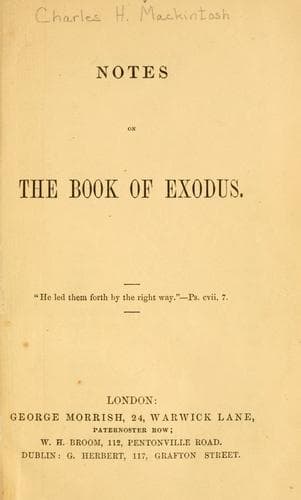
Notes on the book of ExodusMackintosh, Charles Henry
Religion
Notes on the book of Exodus
Mackintosh, Charles Henry
Bible. Exodus -- Commentaries
The Galatians were beginning to accredit a carnal and worldly
religion--a religion of ordinances--a religion of "days, and months,
and times, and years;" and the apostle commences his epistle by
telling them that the Lord Jesus Christ gave Himself for the purpose
of delivering His people from that very thing. God's people must be
separate, not, by any means, on the ground of their superior personal
sanctity, but because they are His people, and in order that they may
rightly and intelligently answer His gracious end in taking them into
connection with Himself, and attaching His name to them. A people
still amid the defilements and abominations of Egypt could not have
been a witness for the Holy One; nor can any one now, while mixed up
with the defilements of a corrupt worldly religion, possibly be a
bright and steady witness for a crucified and risen Christ.
The answer given by Moses to Pharaoh's first objection was a truly
memorable one. "And Moses said, 'It is not meet so to do; for we shall
sacrifice the abomination of the Egyptians to the Lord our God; lo,
shall we sacrifice the abomination of the Egyptians before their eyes,
and will they not stone us? We will go three days' journey into the
wilderness, and sacrifice to the Lord our God, as He shall command
us.'" (Chap. viii. 26, 27.) Here is true separation from Egypt--"three
days' journey." Nothing less than this could satisfy faith. The Israel
of God must be separated from the land of death and darkness, in the
power of resurrection. The waters of the Red Sea must roll between
God's redeemed and Egypt ere they can properly sacrifice to Jehovah.
Had they remained in Egypt, they would have to sacrifice to the Lord
the very objects of Egypt's abominable worship.[5] This would never
do. There could be no tabernacle, no temple, no altar, in Egypt. It
had no site, throughout its entire limits, for aught of that kind. In
point of fact, as we shall see further on, Israel never presented so
much as a single note of praise until the whole congregation stood, in
the full power of an accomplished redemption, on Canaan's side of the
Red Sea. Exactly so is it now. The believer must know where the death
and resurrection of the Lord Jesus Christ have forever set him, ere
he can be an intelligent worshiper, an acceptable servant, or an
effectual witness.
[5] The word "abomination" has reference to that which the Egyptians
worshiped.
Public-domain text, read in full here on John Shaqi.
Reviews
Reviews
No reviews yet
Be the first to share your thoughts on this work.
Elsewhere in the archive
Join the Discussion
Join the discussion
Sign in to leave a comment or review.
Sign InorCreate an account