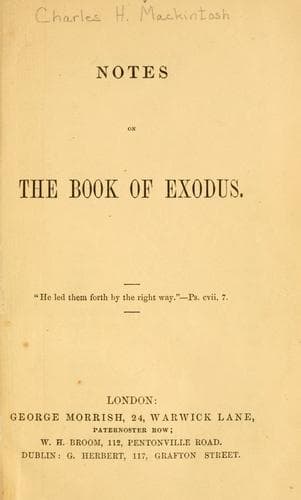
Notes on the book of ExodusMackintosh, Charles Henry
Religion
Notes on the book of Exodus
Mackintosh, Charles Henry
Bible. Exodus -- Commentaries
The third objection demands our most special attention. "And Moses and
Aaron were brought again unto Pharaoh: and he said unto them, 'Go,
serve the Lord your God; but who are they that shall go?' And Moses
said, 'We will go with our young and with our old, with our sons and
with our daughters, with our flocks and with our herds will we go; for
we must hold a feast unto the Lord.' And he said unto them, 'Let the
Lord be so with you, as I will let you go, and your little ones: look
to it; for evil is before you. Not so; go now ye that are men, and
serve the Lord; for that ye did desire.' And they were driven out from
Pharaoh's presence." (Chap. x. 8-11.) Here, again, we have the enemy
aiming a deadly blow at the testimony to the name of the God of
Israel. Parents in the wilderness and their children in Egypt!
Terrible anomaly! This would only have been a half deliverance, at
once useless to Israel and dishonoring to Israel's God. This could not
be. If the children remained in Egypt, the parents could not possibly
be said to have left it, inasmuch as their children were part of
themselves. The most that could be said in such a case was, that in
part they were serving Jehovah, and in part Pharaoh. But Jehovah could
have no part with Pharaoh. He should either have all or nothing. This
is a weighty principle for Christian parents. May we lay it deeply to
heart! It is our happy privilege to count on God for our children, and
to "bring them up in the nurture and admonition of the Lord." (Eph.
vi.) We should not be satisfied with any other portion for "our little
ones" than that which we ourselves enjoy.
Pharaoh's fourth and last objection had reference to the flocks and
herds. "And Pharaoh called unto Moses, and said, 'Go ye, serve the
Lord; only let your flocks and herds be stayed: let your little ones
also go with you.'" (Chap. x. 24.) With what perseverance did Satan
dispute every inch of Israel's way out of the land of Egypt! He first
sought to keep them _in_ the land, then to keep them _near_ the land,
next to keep part of themselves in the land, and finally, when he
could not succeed in any of these three, he sought to send them forth
without any ability to serve the Lord. If he could not keep the
servants, he would seek to keep their ability to serve, which would
answer much the same end. If he could not induce them to sacrifice in
the land, he would send them out of the land without sacrifices.
Public-domain text, read in full here on John Shaqi.
Reviews
Reviews
No reviews yet
Be the first to share your thoughts on this work.
Elsewhere in the archive
Join the Discussion
Join the discussion
Sign in to leave a comment or review.
Sign InorCreate an account