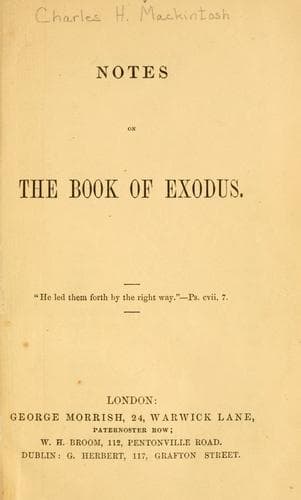
Notes on the book of ExodusMackintosh, Charles Henry
Religion
Notes on the book of Exodus
Mackintosh, Charles Henry
Bible. Exodus -- Commentaries
"And all these thy servants shall come down
unto me, and bow down themselves unto me, saying, Get thee out, and
all the people that follow thee: and after that I will go out." God
will accomplish His own ends. His schemes of mercy must be carried out
at all cost, and confusion of face must be the portion of all who
stand in the way. "O, give thanks unto the Lord; for He is good: for
His mercy endureth forever.... To Him that smote Egypt in their
first-born; for His mercy endureth forever: and brought out Israel
from among them; for His mercy endureth forever: with a strong hand
and with a stretched-out arm; for His mercy endureth forever." (Ps.
cxxxvi.)
"And the Lord spake unto Moses and Aaron in the land of Egypt, saying,
'This month shall be unto you the beginning of months: it shall be the
first month of the year to you.'" (Chap. xii. 1, 2.) There is here a
very interesting change in the order of time. The common or civil year
was rolling on in its ordinary course, when Jehovah interrupted it in
reference to His people, and thus, in principle, taught them that they
were to begin a new era in company with Him; their previous history
was henceforth to be regarded as a blank. Redemption was to constitute
the first step in _real life_.
This teaches a plain truth. A man's life is really of no account until
he begins to walk with God, in the knowledge of full salvation and
settled peace, through the precious blood of the Lamb. Previous to
this, he is, in the judgment of God, and in the language of Scripture,
"dead in trespasses and sins;" "alienated from the life of God." His
whole history is a complete blank, even though, in man's account, it
may have been one uninterrupted scene of bustling activity. All that
which engages the attention of the man of this world--the honors, the
riches, the pleasures, the attractions of life, so called--all, when
examined in the light of the judgment of God, when weighed in the
balances of the sanctuary, must be accounted as a dismal blank, a
worthless void, utterly unworthy of a place in the records of the Holy
Ghost. "He that believeth not the Son shall not see life." (John iii.
36.) Men speak of "seeing life" when they launch forth into society,
travel hither and thither, and see all that is to be seen; but they
forget that the only true, the only real, the only divine way to "see
life," is to "believe on the Son of God."
Public-domain text, read in full here on John Shaqi.
Reviews
Reviews
No reviews yet
Be the first to share your thoughts on this work.
Elsewhere in the archive
Join the Discussion
Join the discussion
Sign in to leave a comment or review.
Sign InorCreate an account