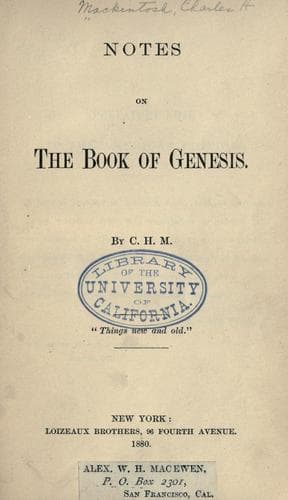
Notes on the Book of GenesisMackintosh, Charles Henry
Religion
Notes on the Book of Genesis
Mackintosh, Charles Henry
Bible. Genesis -- Commentaries
Again, there is the laughter with which unbelief fills our mouths, when
God's promises are too magnificent for our narrow hearts to take in, or
the visible agency too small in our judgment for the accomplishment of
his grand designs. The first of these we are never ashamed or afraid to
avow. Zion's sons are not ashamed to say, "then was our mouth filled
with laughter." (Ps. cxxvi. 2.) When Jehovah makes us to laugh, we may
laugh heartily. "But Sarah denied, saying, I laughed not; for she was
afraid." Unbelief makes us cowards and liars; faith makes us bold and
truthful. It enables us to "come boldly," and to "draw near with true
hearts."
But, further, Abraham is made the depositary of God's thoughts and
counsels about Sodom. Though having nothing to do with it personally,
yet he was so near the Lord that he was let into his mind in reference
to it. The way to know the divine purposes about this present evil
world, is not to be mixed up with it in its schemes and speculations,
but to be entirely separated from it. The more closely we walk with
God, and the more subject we are to his word, the more we shall know of
his mind about every thing. I do not need to study the newspaper in
order to know what is going to happen in the world. God's word reveals
all I want to know. In its pure and sanctifying pages I learn all about
the character, the course, and the destiny of the world; whereas, if I
go to the men of the world for news, I may expect that the devil will
use them to cast dust in my eyes.
Had Abraham visited Sodom in order to obtain information about its
facts, had he applied to some of its leading intelligent men, to know
what they thought of Sodom's present condition and future prospects,
how would he have been answered? Doubtless they would have called his
attention to their agricultural and architectural schemes, the vast
resources of the country; they would have placed before his eyes one
vast, mingled scene of buying and selling, building and planting,
eating and drinking, marrying and giving in marriage. Doubtless, too,
they would never dream of judgment, and if any one had made mention
thereof, their mouths would have been filled with infidel laughter.
Hence, then, it is plain, that Sodom was not the place in which to
learn about Sodom's end. No; "the place, where Abraham stood before the
Lord," afforded the only proper point from whence to take in the whole
prospect. There he could stand entirely above the fogs and mists which
had gathered upon Sodom's horizon. There, in the clearness and calmness
of the divine presence, he could understand it all. And what use did he
make of his knowledge and his elevated position? How was he occupied in
the Lord's presence? The answer to these inquiries leads us to the
third special privilege enjoyed by our patriarch in this chapter,
namely,--
Public-domain text, read in full here on John Shaqi.
Reviews
Reviews
No reviews yet
Be the first to share your thoughts on this work.
Elsewhere in the archive
Join the Discussion
Join the discussion
Sign in to leave a comment or review.
Sign InorCreate an account