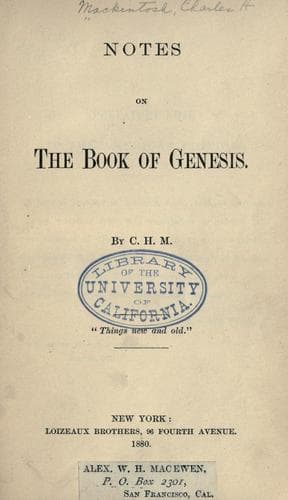
Notes on the Book of GenesisMackintosh, Charles Henry
Religion
Notes on the Book of Genesis
Mackintosh, Charles Henry
Bible. Genesis -- Commentaries
Abraham is now in a fit moral position to have his heart put to a most
severe test. The long-cherished reserve being put forth from his heart,
in Chap. xx.--the bond-woman and her son being put forth from his
house, as in Chap. xxi., he now stands forth in the most honored
position in which any soul can be placed, and that is a position of
trial from the hand of God himself. There are various kinds of trial:
trial from the hand of Satan; trial from surrounding circumstances; but
the highest character of trial is that which comes directly from the
hand of God, when he puts his dear child into the furnace for the
purpose of testing the reality of his faith. God will do this: he must
have reality. It will not do to say, "Lord, Lord," or, "I go, sir." The
heart must be probed to the very bottom, in order that no element of
hypocrisy or false profession may be allowed to lodge there. "My son,
give me _thine heart_." He does not say, "Give me thine head, or thine
intellect, or thy talents, or thy tongue, or thy money;" but "Give me
thine heart:" and in order to prove the sincerity of our response to
this gracious command, he will lay his hand upon something very near
our hearts. Thus he says to Abraham, "Take now thy son, thine only son
Isaac, whom thou lovest, and get thee into the land of Moriah, and
offer him there for a burnt-offering, upon one of the mountains which I
will tell thee of." This was coming very close to Abraham's heart. It
was passing him through a searching crucible indeed. God "requires
truth in the inward parts." There may be much truth on the lips, and
much in the intellect, but God looks for it in the heart. It is no
ordinary proof that will satisfy God, as to the love of our hearts. He
himself did not rest satisfied with giving an ordinary proof. He gave
his Son, and we should aim at giving very striking proofs of our love
to him who so loved us, even when we were dead in trespasses and sins.
Public-domain text, read in full here on John Shaqi.
Reviews
Reviews
No reviews yet
Be the first to share your thoughts on this work.
Elsewhere in the archive
Join the Discussion
Join the discussion
Sign in to leave a comment or review.
Sign InorCreate an account