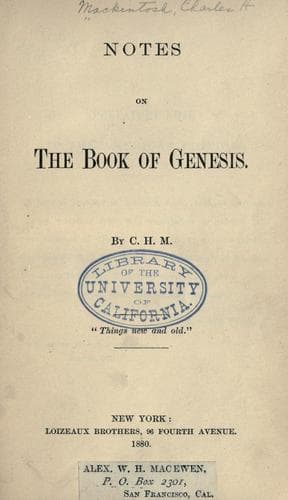
Notes on the Book of GenesisMackintosh, Charles Henry
Religion
Notes on the Book of Genesis
Mackintosh, Charles Henry
Bible. Genesis -- Commentaries
At the close of this chapter we are presented with some principles of a
very solemn and practical nature. Jacob's character and actings will
hereafter, if the Lord will, come more fully before us; but I would
just notice, ere passing on, the conduct of Esau in reference to the
birthright, and all which it involved. The natural heart places no
value on the things of God. To it God's promise is a vague, valueless,
powerless thing, simply because God is not known. Hence it is that
present things carry such weight and influence in man's estimation. Any
thing that man can _see_ he values, because he is governed by sight,
and not by faith. To him the present is every thing: the future is a
mere uninfluential thing,--a matter of the merest uncertainty. Thus it
was with Esau. Hear his fallacious reasoning: "Behold, I am at the
point to die; and what profit shall this birthright do to me?" What
strange reasoning! _The present_ is slipping from beneath my feet: I
will therefore despise and entirely let go the _future_! Time is
fading from my view, I will therefore abandon all interest in eternity!
"Thus Esau despised his birthright." Thus Israel despised the pleasant
land; (Ps. cvi. 24); thus they despised Christ. (Zech. xi. 13.) Thus
those who were bidden to the marriage despised the invitation. (Matt.
xxii. 5.) Man has no heart for the things of God. The present is every
thing to him. A mess of pottage is better than a title to Canaan.
Hence, the very reason why Esau made light of the birthright was the
reason why he ought to have grasped it with the greater intensity. The
more clearly I see the vanity of man's present, the more I shall cleave
to God's future. Thus it is in the judgment of faith. "Seeing then that
_all these things shall be dissolved_, what manner of persons ought ye
to be in all holy conversation and godliness; looking for and hasting
unto the coming of the day of God, wherein the heavens being on fire
shall be dissolved, and the elements shall melt with fervent heat?
Nevertheless we, _according to his promise_, look for new heavens and a
new earth, wherein dwelleth righteousness." (2 Pet. iii. 11-13.) These
are the thoughts of God, and therefore the thoughts of faith. The
things that are seen shall be dissolved. What, then, are we to despise
the unseen? By no means. The present is rapidly passing away. What is
our resource? "Looking for, and hasting unto, the coming of the day of
God." This is the judgment of the renewed mind; and any other judgment
is only that of "a profane person, as Esau, who for one morsel of meat
sold his birthright." (Heb. xii. 16.) The Lord keep us judging of
things as he judges. This can only be done by faith.
CHAPTER XXVI.
Public-domain text, read in full here on John Shaqi.
Reviews
Reviews
No reviews yet
Be the first to share your thoughts on this work.
Elsewhere in the archive
Join the Discussion
Join the discussion
Sign in to leave a comment or review.
Sign InorCreate an account