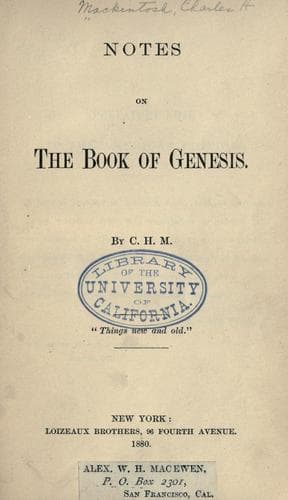
Notes on the Book of GenesisMackintosh, Charles Henry
Religion
Notes on the Book of Genesis
Mackintosh, Charles Henry
Bible. Genesis -- Commentaries
And yet, alas! it is no uncommon thing to find the children of God thus
forgetting their high destinies and heavenly inheritance, and
descending into the arena with the children of this world, to struggle
there for the riches and honors of a perishing, sin-stricken earth.
Indeed, to such an extent is this true, in many instances, that it is
often hard to trace a single evidence of that principle which St. John
tells us "overcometh the world." Looking at Jacob and Laban, and
judging of them upon natural principles, it would be hard to trace any
difference. One should get behind the scenes, and enter into God's
thoughts about both, in order to see how widely they differed. But it
was God that had made them to differ, not Jacob; and so it is now.
Difficult as it may be to trace any difference between the children of
light and the children of darkness, there is nevertheless a very wide
difference indeed,--a difference founded on the solemn fact that the
former are "the vessels of mercy, which God has afore prepared unto
glory," while the latter are "the vessels of wrath, fitted (not by God,
but by sin) to destruction."[18] (Rom. ix. 22, 23.) This makes a very
serious difference. The Jacobs and the Labans differ materially, and
have differed, and will differ forever, though the former may so sadly
fail in the realization and practical exhibition of their true
character and dignity.
Now, in Jacob's case, as set forth in the three chapters now before us,
all his toiling and working, like his wretched bargain before, is the
result of his ignorance of God's grace, and his inability to put
implicit confidence in God's promise. The man that could say, after a
most unqualified promise from God to give him the whole land of Canaan,
"IF God will give me food to eat and raiment to put on," could have had
but a very faint apprehension of who God was, or what his promise was
either; and because of this, we see him seeking to do the best he can
for himself. This is always the way when grace is not understood: the
principles of grace may be professed, but the real measure of our
experience of the power of grace is quite another thing. One would have
imagined that Jacob's vision had told him a tale of grace; but God's
revelation at Bethel, and Jacob's actings at Haran, are two very
different things; yet the latter tell out what was Jacob's sense of the
former. Character and conduct prove the real measure of the soul's
experience and conviction, whatever the profession may be. But Jacob
had never yet been brought to measure himself in God's presence, and
therefore he was ignorant of grace, and he proved his ignorance by
measuring himself with Laban, and adopting his maxims and ways.
Public-domain text, read in full here on John Shaqi.
Reviews
Reviews
No reviews yet
Be the first to share your thoughts on this work.
Elsewhere in the archive
Join the Discussion
Join the discussion
Sign in to leave a comment or review.
Sign InorCreate an account