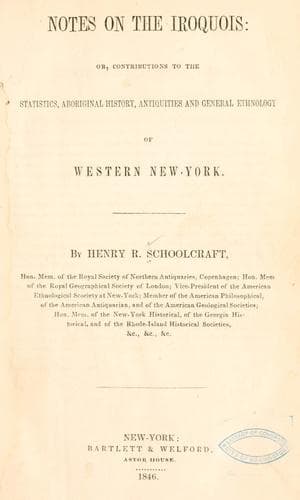
Notes on the Iroquois: or, Contributions to the Statistics, Aboriginal History, Antiquities and General Ethnology of Western New-YorkSchoolcraft, Henry Rowe
History
Notes on the Iroquois: or, Contributions to the Statistics, Aboriginal History, Antiquities and General Ethnology of Western New-York
Schoolcraft, Henry Rowe
Indians of North America -- New York (State); Iroquois Indians
Nabikoáguna Mnemonic. Fig. 1, plate IV. This is the head of an infant
represented in the fine red pipe-stone from the Missouri. Locality,
site of the ancient fort of the Kasonda valley. [I. Keeler, junior.]
[Illustration: AMERICAN ANTIQUITIES—Plate IV.]
CLASS SECOND.—MEDÄEKA.
This class comprises the amulets proper. All the objects of this class
are supposed to have been worn on various parts of the person, as a
defence against witchcraft, sorcery, or spells, or to propitiate good
luck by superstitious means.
Medäeka Missouri. See Fig. 1, Plate V, with the illustration of the
manner of its being worn on the breast. This article varies moderately
in length, breadth and figure. It is generally the frustum of an acute
pyramid, perforated in its length, to admit being suspended from
the neck, or ears. The figure exhibited is three inches in length
by two-tenths in breadth at its superior, and nine-tenths at its
inferior extremity. Sometimes, as in the figure given, it has a raised
surface in the direction of the perforation. It is formed of the red
pipe-stone of the Coteau Des Prairie, west of the Mississippi; and its
disinterment from Indian graves in western New-York, denotes an early
traffic or exchange of the article, or rather the material of its
construction, with the tribes in that quarter. This stone is fissile,
and easily cut or ground by trituration with harder substances to any
figure. It bears a dull gloss, not a polish, which was produced by
rubbing the surface with the equisetum, or rush, which has a silicious
gritty surface. It is of the period anterior to the introduction of
European arts. The specimen figured is from Onondaga county, [I. V. V.
Clarke.] It occurred also at Oswego, in removing the elevation of the
old fort. [J. McNiel.] Also, at Lower Sandusky, Ohio. [L. Cass.]
[Illustration: AMERICAN ANTIQUITIES.—Plate V.]
Medäeka Dental. Fig. 4, 5. Plate VI. Fossil specimens of the bear’s
tooth. A power against charms or spells was often attributed to amulets
of this kind. The two species, very different in size, and of course
the age of the animal, were obtained from a single grave. Valley of the
Genesee river. [E. Trowbridge.]
Medäeka Okun. Fig. 3, Plate VI. This species is made from a compact
kind of bone, squared and perforated. Valley of the Genesee river. [E.
Trowbridge.] From an ancient grave.
[Illustration: AMERICAN ANTIQUITIES.—Plate VI.]
CLASS THIRD.—ATTAJEGUNA.[71]
[71] From the Algonquin JEEGUN, an instrument, an implement,
or any artificial contrivance, or invention.
Public-domain text, read in full here on John Shaqi.
Reviews
Reviews
No reviews yet
Be the first to share your thoughts on this work.
Elsewhere in the archive
Join the Discussion
Join the discussion
Sign in to leave a comment or review.
Sign InorCreate an account