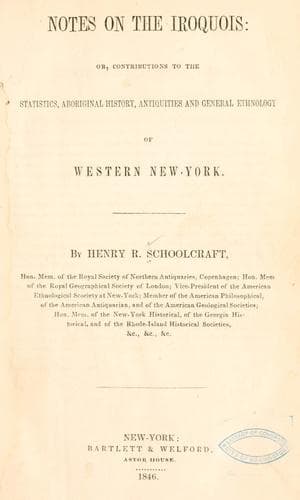
Notes on the Iroquois: or, Contributions to the Statistics, Aboriginal History, Antiquities and General Ethnology of Western New-YorkSchoolcraft, Henry Rowe
History
Notes on the Iroquois: or, Contributions to the Statistics, Aboriginal History, Antiquities and General Ethnology of Western New-York
Schoolcraft, Henry Rowe
Indians of North America -- New York (State); Iroquois Indians
The war, however, instead of calling out the banded energies of the
confederacy, appears to have been almost entirely one of a partizan
character. It is memorable rather for partial enterprizes and personal
exploits, than for exhibiting the grander features of the military
policy of the Iroquois. Warriors tested their bravery and heroism by
going against the Cherokees. There were, it seems, no great armies,
no grand battles. All was left to individual energy and courage. The
great object of every young Iroquois, as soon as he was old enough to
take the war path, was to go against the Cherokees. A march from the
Oneida stone, the Kasonda creek, or the Genesee valley, to the southern
Alleghanies, was regarded as a mere excursion or scouting trip. This
long journey was performed without provisions, or any other preparation
than bows, arrows and clubs. The fewer there were in one of these
partizan enterprizes, the greater was their chance of concealment and
success. They relied on the forest for food. Thousands of miles were
not sufficient to dampen their ardor, and no time could blot out their
hatred. They called the Cherokees, by way of derision, WE YAU
DAH, and O YAU DAH, meaning a people who live in caves.
These are the terms I found to be in use for the Cherokee nation, in
1845.
[c.] Exploit of Hi-a-de-o-ni.
The following incident in the verbal annals of Iroquois hardihood and
heroism, was related to me by the intelligent Seneca TETOYOAH,
(William Jones of Cattaraugus) along with other reminiscences of the
ancient Cherokee wars. The Iroquois thought life was well lost, if they
could gain glory by it.
* * * * *
HI-A-DE-O-NI, said he, was the father of the late chief Young
King. He was a Seneca warrior, a man of great prowess, dexterity, and
swiftness of foot, and had established his reputation for courage and
skill, on many occasions. He resolved, while the Senecas were still
living on the Genesee river, to make an incursion alone into the
country of the Cherokees. He plumed himself with the idea, that he
could distinguish himself in this daring adventure, and he prepared for
it, according to the custom of warriors. They never encumber themselves
with baggage. He took nothing but his arms, and the meal of a little
parched and pounded corn.[82] The forest gave him his meat.
* * * * *
[82] One table spoonful of this mixed with sugar and water will sustain
a warrior twenty-four hours without meat.
Public-domain text, read in full here on John Shaqi.
Reviews
Reviews
No reviews yet
Be the first to share your thoughts on this work.
Elsewhere in the archive
Join the Discussion
Join the discussion
Sign in to leave a comment or review.
Sign InorCreate an account