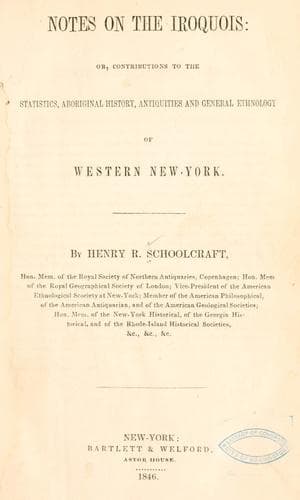
Notes on the Iroquois: or, Contributions to the Statistics, Aboriginal History, Antiquities and General Ethnology of Western New-YorkSchoolcraft, Henry Rowe
History
Notes on the Iroquois: or, Contributions to the Statistics, Aboriginal History, Antiquities and General Ethnology of Western New-York
Schoolcraft, Henry Rowe
Indians of North America -- New York (State); Iroquois Indians
The Indian name of Batavia is Ge-ne-un-dah-sais-ka, meaning musquito.
This was the name by which they knew the late Mr. Ellicott.
* * * * *
The Tonewanda falls 40 feet at a single place, within the Indian
reservation. It heads on high ground about 40 miles above Batavia. On
the theory of the former elevation of lake Erie, Buffalo itself would
be the highest ground, between Batavia and the lake, in a direct line.
Attica, is perhaps more elevated in that direction.
TONEWANDA RES. [Winsor & Richards.]
NAME OF SENECAS.
The Senecas call themselves NUN-DO-WAW-GAW, or people of the
hill. The term Seneca is taken from the lake, on the banks of which
they formerly lived, and had their castle. It is _not_ a name of Indian
origin. They are called NUN-DO-WAW-GAW, from the eminence
called Fort-Hill, near Canandaguia lake. [Ho-ho-ee-yuh, or J. A.
Sanford.]
CHEROKEES.
They call the Cherokees O-YAU-DAH, which means a people who
live in caves. Their enmity against this people, the tradition of which
is so strong and clear, is stated to have originated from the contact
of war and hunting parties, in the plains of the southwest. The Senecas
affirm that the Cherokees robbed and plundered a Seneca party and took
away their skins. Retaliation ensued. Tragic scenes of treachery and
surprise followed. The Five Nations took up the matter in all their
strength, and raised large and strong war parties, who marched through
the country to the Cherokee borders, and fought and plundered the
villages, and brought away scalps and prisoners. There are now, (1845)
descendants of Cherokees in the third degree, living on the Tonewanda
reservation. [Ho-ho-ee-yuh.] Some years ago, a chief of this blood,
pure by father and mother, lived among them, who had been carried
off captive when a boy. The fact being revealed to him, after he had
obtained the chieftaincy, he went south to seek his relations and live
and die among them, but he was unable to find them. He came back to the
Senecas, and died among them. [Le Fort.]
TONEWANDA.
The most curious trait, of which we know but little, is that respecting
TOTEMS.
Asked the chief called Blacksmith, his name in Seneca. He replied,
De-o-ne-hoh-gah-wah, that is, a door perforated, or violently broken
through, not opened. Says he was born on the Tonewonda reservation,
and wishes to die there; will be 60 years old, if he lives till next
winter, 1846.
Says the Senecas call the Fort Stanwix or Rome summit, De-o-wain-sta,
meaning the place where canoes are carried across the land from stream
to stream; that is, a carrying place.
Says, Te-to-yoah, or Wm. Jones of Cattaraugus, can relate valuable
Seneca traditions.
He says there are eight Seneca clans; they are the Wolf, Bear, Turtle,
Deer, Plover, Beaver, Hawk and Crane. He is of the Wolf clan. This was
also Red Jacket’s clan.
Public-domain text, read in full here on John Shaqi.
Reviews
Reviews
No reviews yet
Be the first to share your thoughts on this work.
Elsewhere in the archive
Join the Discussion
Join the discussion
Sign in to leave a comment or review.
Sign InorCreate an account