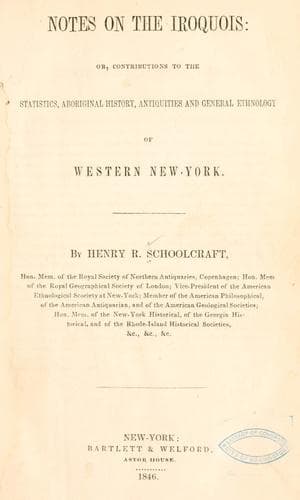
Notes on the Iroquois: or, Contributions to the Statistics, Aboriginal History, Antiquities and General Ethnology of Western New-YorkSchoolcraft, Henry Rowe
History
Notes on the Iroquois: or, Contributions to the Statistics, Aboriginal History, Antiquities and General Ethnology of Western New-York
Schoolcraft, Henry Rowe
Indians of North America -- New York (State); Iroquois Indians
During the thirteen years that I have superintended these schools,
nearly thirty different persons have engaged for a longer or shorter
time, as teachers. For the past year there have been four schools under
the patronage of the American Board, and one under the Society of
Friends. The whole number who have been instructed in the five schools
is probably not far from one hundred and twenty-five. The attendance of
a part has been very irregular, sometimes shifting from one school to
another, and sometimes attending no school at all. Several of the early
pupils in the mission schools are now heads of families, well informed,
industrious, temperate and religious, and in good circumstances. Some
are interpreters, some teachers of schools, and others engaged in
transacting the business of the nation.
You can, sir, best judge of the influence of the gospel in promoting
worldly prosperity, when you have fully completed the census which
is now being taken. When you count up the framed houses and barns,
the horses, cattle, sheep and hogs, the acres of improved land, with
the wagons, buggies and sleighs, clocks and watches, and the various
productions of agriculture, you can easily conceive the difference
between the present, and thirty years ago. I suppose there was not
then a framed building of any description, and scarcely a log house,
properly so called, no teams, no roads, no ploughed land, and but small
patches of corn, beans and squashes. What an astonishing change!
As to the capacity of Indian children for improvement, my own
impression is that there is no essential difference between them
and white children. The fact that Indian children usually make slow
progress in studying English books, can be accounted for in three ways:
1. They generally have little or no assistance from their parents at
home. 2. They are irregular in their attendance on schools, for want of
order and discipline on the part of parents. 3. Being ignorant of the
English language, it is a long time before they comprehend fully the
instruction of their teachers.
These circumstances operate to make the school room a very dull and
uninteresting place to the scholar, and the reflex influence gives
the scholar the same appearance. When they can once rise above these
circumstances, and overcome these obstacles, they make good proficiency
in their studies.
Believing that these statements cover the ground of your inquiries, I
subscribe myself, dear sir,
Respectfully and truly yours,
ASHER BLISS.
P. S. Should you desire further information on any of these points,
or upon others, which have been omitted, please state your questions
definitely, in writing.
Yours, &c.,
A. B.
(K.)
Letter from Rev. William Hall to Henry R. Schoolcraft.
_Allegany Mission, Sept. 8th, 1845._
DEAR SIR:—Your inquiries in relation to the state of
religion, education, &c., among the Indians of this reservation, if I
rightly understand them, are briefly answered as follows:
Public-domain text, read in full here on John Shaqi.
Reviews
Reviews
No reviews yet
Be the first to share your thoughts on this work.
Elsewhere in the archive
Join the Discussion
Join the discussion
Sign in to leave a comment or review.
Sign InorCreate an account