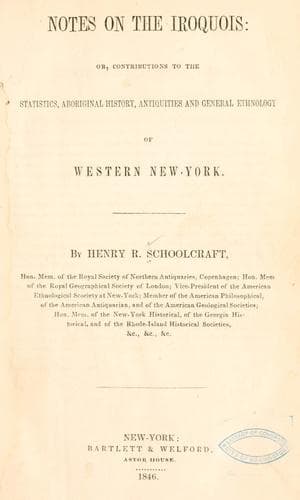
Notes on the Iroquois: or, Contributions to the Statistics, Aboriginal History, Antiquities and General Ethnology of Western New-York — John Shaqi
Notes on the Iroquois: or, Contributions to the Statistics, Aboriginal History, Antiquities and General Ethnology of Western New-YorkSchoolcraft, Henry Rowe
History
Notes on the Iroquois: or, Contributions to the Statistics, Aboriginal History, Antiquities and General Ethnology of Western New-York
Schoolcraft, Henry Rowe
Indians of North America -- New York (State); Iroquois Indians
various rich vallies, abounding in game, nuts and fish, was a rapid
increase in population. The next, to become overbearing, quarrel about
territory, and fight. They were compelled to build forts to defend
their stations, or secure their women and children, at night, and
by this system, kept down their population to about its first point
of increase. It is altogether probable that they did not more than
maintain, for ages, a stationary population, which occasionally went
down by disease and other calamities, and again revived, as we know
that natural causes, in the laws of vitality, will revive a people
quickly, after the scourge of pestilence.
The idea of a confederation was, it is believed, an old one with this
people, for the very oldest traditions speak of something of this kind,
among the lake and St. Lawrence tribes of older days. When the present
league was formed, on the banks of the Onondaga lake, this central
tribe had manifestly greatly increased in strength, and distinguished
itself in arms, and feats of hunting and daring against giants and
monsters, for in such rencontres their traditions abound.
[Illustration]
Most distinguished, however, above all others, east or west, was a
leader of great courage, wisdom and address, called Atotarho; and
when they proposed to form a league, this person, who had inspired
dread, and kept himself retired, was anxiously sought. He was found,
by the Mohawk embassy, who were charged with the matter, sitting as
he is represented in the annexed cut, composedly in a swamp, smoking
his pipe, and rendered completely invulnerable, by living serpents.
These animals extended their hissing heads from all parts of his head
and body. Every thing about him, and the place of his residence, was
such as to inspire the utmost fear and respect. His dishes and spoons
were made of the skulls of enemies, whom he had slain in battle. Him,
when they had duly approached with presents and burned tobacco in
friendship, in their pipes, by way of frankincense, they placed at the
head of their league, as its presiding officer. They collected a large
quantity of wampum, and invested him with a broad belt of this sacred
article. I found the original drawing of this personage, from which the
above is reduced, in the summer of 1845, in the house of a Seneca on
the Cattaragus reservation. The owner of this curious pictorial relic,
on being asked, proceeded to a chest and carefully took it from its
envelope, and allowed me to make a copy. It represents Atotarho, at the
moment of his discovery, by the Mohawk delegation.
The right thus awarded to the Onondagas, to furnish a presiding officer
for the league, has ever been retained, and is still possessed by that
canton. To the Mohawks, at the same time, was awarded the Tekarahogea,
or chief war captain—an office, however, of the general recognition of
which, there is a disagreement amongst interpreters.
Public-domain text, read in full here on John Shaqi.
Reviews
Reviews
No reviews yet
Be the first to share your thoughts on this work.
Join the Discussion
Join the discussion
Sign in to leave a comment or review.
Sign InorCreate an account