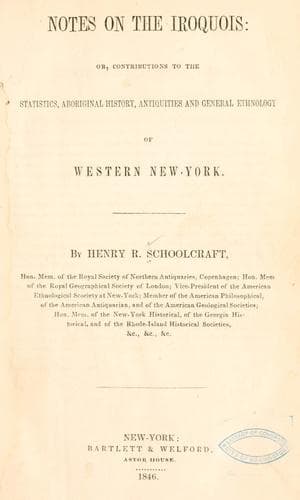
Notes on the Iroquois: or, Contributions to the Statistics, Aboriginal History, Antiquities and General Ethnology of Western New-YorkSchoolcraft, Henry Rowe
History
Notes on the Iroquois: or, Contributions to the Statistics, Aboriginal History, Antiquities and General Ethnology of Western New-York
Schoolcraft, Henry Rowe
Indians of North America -- New York (State); Iroquois Indians
To preserve their nationality, their sachems, about the year 1820, sent
delegates west to look out a location for their permanent residence.
They purchased a suitable territory from the Monomonees of Wisconsin,
a wandering and non-industrious race, seated about Green Bay, and
expended a part of their annuities in the payment. This turned out
a wise measure. They soon began to remove, and have at this time a
very flourishing settlement on Duck river, in that territory. At that
location they have established schools, temperance societies and a
church. They bear a good reputation for morals and industry, and are
advancing in civilization and the arts.
By an official return of the date of 1844, they numbered 722 persons
at that settlement. Two hundred and ten are still seated within the
boundaries of New-York, mostly in Oneida county. They are a mild
people, of a good stature, and easy manners, and speak a soft dialect
of the Iroquois, abounding in the liquid _l_, which, together with a
mild enunciation, imparts a pleasing character to their speech.
[_c._] Onondagas.
Onondaga was, from the remotest times, the seat of the Iroquois
government. Granting credence to the account of their own origin, on
the high grounds or falls of the Oswego, they had not proceeded far up
the course of the widely gathered waters of this stream, when a portion
of them planted their wigwams in this fertile region. Whatever was the
cause of their migrating from their primary council fire, nothing was
more natural than that, by pursuing this stream upward, they should
separate into independent tribes, and by further tracing out its far
spread forks, gradually expand themselves, as they were found by
the discoverers and first settlers, over the entire area of western
New-York. On reaching the grand junction of Three River Point, a part
went up the Seneca river, who subsequently dividing, formed the Senecas
and Cayugas. The bands who took the eastern fork, or Oneida river,
pushed forward over the Deowainsta, or Rome summit, into the first
large stream, flowing east, and became the Mohawks. The central or
Onondaga fork was chosen by the portion who, from the hill country they
first located in, took this name; and from them, the Oneidas, pursuing
in fact the track of the Mohawks, were an off-shoot. That such was
the general route, and causes of their separation, appears as evident
as strong probabilities, in coincidence with their own traditions and
modern discovery, can make it. That the whole of the original number
who started from the south banks of Lake Ontario, did not keep together
till they reached the valley of the Hudson and the sea, and then go
back to the west,—for so their general tradition has it, is also both
reasonable and probable to suppose. Large bodies of hunters cannot keep
long together. They must separate to procure food, and would separate
from other causes. The first effect of their separation and spread into
Public-domain text, read in full here on John Shaqi.
Reviews
Reviews
No reviews yet
Be the first to share your thoughts on this work.
Join the Discussion
Join the discussion
Sign in to leave a comment or review.
Sign InorCreate an account