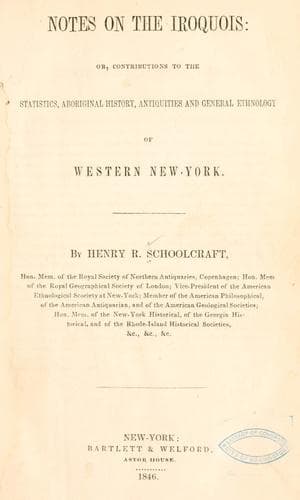
Notes on the Iroquois: or, Contributions to the Statistics, Aboriginal History, Antiquities and General Ethnology of Western New-YorkSchoolcraft, Henry Rowe
History
Notes on the Iroquois: or, Contributions to the Statistics, Aboriginal History, Antiquities and General Ethnology of Western New-York
Schoolcraft, Henry Rowe
Indians of North America -- New York (State); Iroquois Indians
A singular tradition may be here added. It is said that the XIIIth
Atotarho reigned at Onondaga when America was discovered. [D.]
Giving to each Atotarho[33] a rule of fifteen years, and taking
Hudson’s voyage as the period the Indians allude to, we should have
A. D. 1414, as the era of the present confederacy, in place of 1539,
before mentioned on the authority of a general tradition recorded
by Pyrlaus. We cannot, however, place much reliance upon Cusick’s
chronology.
[33] Incidental circumstances have led to the substitution of the above
head for the original figure.
[_d._] Cayugas.
The history of this canton does not stand out prominently among the
Iroquois while it will be found that as one of the inclusive tribes who
carried their name and fame so high among the aborigines, they have
performed their due part, and produced warriors, sages and speakers of
eminence. Were every thing else, indeed, blotted out of their history,
the fact of their having produced a Logan[34] would be sufficient to
rescue their memory from oblivion. In their early search after a place
to hunt, fish and plant corn, as an independent tribe, they, on the
assumption of their own traditions, passed up the Seneca river, into
the sylvan and beautiful lake which bears their name. In visiting this
lake the present year, in search of their ancient sites, it was not
without a melancholy interest, that I surveyed, within the boundaries
of Aurora, the remains of one of those apple orchards, which were
ruthlessly cut down by a detachment of the army of Gen. Sullivan, in
his severe but necessary expedition in 1778. Many vestiges of their
ancient residence still remain in Cayuga county, nor has local memory,
in its intelligent and hospitable inhabitants, dropped from its scroll
the names of several of its distinguished chiefs, and their places
of abode. They point to a spot at Springport, now trenched on by the
road, where lie the remains of Karistagea, better known by his English
appellative of Steeltrap, one of their noted chiefs and wise men,
who extended the hospitalities of his lodge to the first settlers on
the “Military Tract.” The nation itself, although they had fought
strenuously under the Red Cross of St. George in the Revolutionary
war, appeared to be composed of mild and peaceable men, of friendly
dispositions towards the settlers. They brought venison, fish and wild
fruits for sale to the doors of families, whose elder branches yet
dwell upon the shores of the Cayuga.
[34] Logan was the son of Skellelimus, a Cayuga, and went early to the
Ohio valley, if he were not born there.
Public-domain text, read in full here on John Shaqi.
Reviews
Reviews
No reviews yet
Be the first to share your thoughts on this work.
Join the Discussion
Join the discussion
Sign in to leave a comment or review.
Sign InorCreate an account