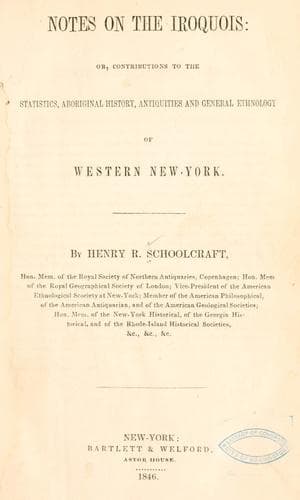
Notes on the Iroquois: or, Contributions to the Statistics, Aboriginal History, Antiquities and General Ethnology of Western New-YorkSchoolcraft, Henry Rowe
History
Notes on the Iroquois: or, Contributions to the Statistics, Aboriginal History, Antiquities and General Ethnology of Western New-York
Schoolcraft, Henry Rowe
Indians of North America -- New York (State); Iroquois Indians
Yet their history is a melancholy one, and their decline, on the
settlement of Western New-York, was probably one of the most striking
instances of the rapid depopulation of a tribe in modern days. Their
first cession of land to the State was in 1789. This was confirmed
at the general treaty of Fort Stanwix in 1790, and such had been the
pressure of emigration into that quarter, that in 1795, at a treaty
held at Cayuga bridge, they ceded their reserve of one hundred miles
square in the valley of the Seneca outlet and the basin of Cayuga
lake, reserving but four miles square. In these treaties they deemed
themselves wise to change into large money annuities,[35] a territory
which was no longer useful for hunting, and which they did not
cultivate.
[35] A perpetual annuity of $2,300 was secured by one of these treaties.
Experience has shown, however, throughout America, that Indian tribes,
who live on annuities, and not by agricultural labor, are in the most
dangerous condition of rapid decline. To render the danger eminent, it
needs but the close proximity of a European population, who present
the means of indulging selfish gratifications. Among these means, so
seductive to the Indian mind, ardent spirits have ever been the most
baneful. It proved so at least with the Cayugas, for within sixteen
years after the treaty of Fort Stanwix, they had all emigrated west.
Some of them had rejoined their brethren, who followed Brant and the
Mohawks to Canada. Some had migrated to Sandusky, in Ohio, and others
found a refuge among the Senecas, near Buffalo. With the Senecas they
have ever been on most intimate terms. Whilst they lived on the Cayuga
lake, and the latter on the Seneca, they were separated by a midland
range of forest, little more than 16 miles broad. They intermingled
freely in their hunting parties, and even in their villages. The
inhabitants still point to a large tree near Canoga, on the banks of
Cayuga lake, where the celebrated orator Red Jacket was born.
Public-domain text, read in full here on John Shaqi.
Reviews
Reviews
No reviews yet
Be the first to share your thoughts on this work.
Join the Discussion
Join the discussion
Sign in to leave a comment or review.
Sign InorCreate an account