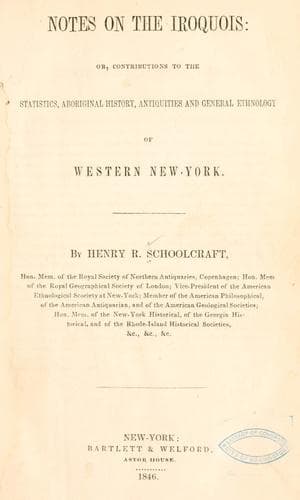
Notes on the Iroquois: or, Contributions to the Statistics, Aboriginal History, Antiquities and General Ethnology of Western New-YorkSchoolcraft, Henry Rowe
History
Notes on the Iroquois: or, Contributions to the Statistics, Aboriginal History, Antiquities and General Ethnology of Western New-York
Schoolcraft, Henry Rowe
Indians of North America -- New York (State); Iroquois Indians
In investigating the Indian population of New-York, under the
provisions of the census act, I found 114 Cayugas residing in twenty
families, on the Cattaragus reservation. These families cultivate 316
acres of land, and during the year 1845, they raised 1,970 bushels
of corn, 1,622 of oats, 210 of wheat, 955 of potatoes, and 277 of
buckwheat, besides esculents and small articles. They were found to
possess 43 milch cows, 39 horses, 40 sheep, and 109 hogs. Besides
the Cayugas residing on the Cattaragus, there were found, dispersed
among the other cantons, 83 persons; making the whole number within
the boundaries of New-York, 197. The style of their dwellings is,
generally, that of squared timber, plainly but comfortably furnished,
with glass windows, and plain common furniture. Sixteen of the number
are members of Protestant churches. The males dress exclusively in the
European fashion, and their condition and prospects are, like those of
the Senecas, among whom they dwell, in a high degree encouraging to
the friends of humanity. Of the number out of the bounds of the State,
there have been no accurate means of judging. The vocabulary of their
language (vide appendix O) will denote its close affinities with other
tribes of this family.
From a remark made to me, by a daughter of Brant, (the late Mrs. Kerr,)
at her house near Wellington square, Canada, in 1843, I am inclined
to think, that in the early wars waged by the Iroquois against the
Virginia Indians, the Cayugas defeated and made prisoners the remnant
of the Tuteloes, whom they brought and settled among them, in the
Cayuga country.
[_e._] History and origin of the Senecas.
One of the first traits which strikes an observer on entering the
territory of this tribe, is the fact that they are called by a name
which is not known in their vocabulary, and which they only recognize
from having long been thus designated by others. Identical as it is in
its present orthography, with the name of the Roman moralist, it is yet
wholly improbable that it had any such origin; it must be regarded as
an accidental coincidence of sound in some other Indian tongue. That
this tongue is the Mohawk, a people who stood first in position east
on the Iroquois borders, is probable, but not certain. The earlier
authors spelt it with a _k_, with the _a_ final, which probably had the
usual broad sound. It occurs on a map of 1614, which was brought over
from Holland recently, by the historical agent of the State, and has
been laid, by that gentleman, before the New-York Historical Society,
with the proofs of its genuineness, thus bringing the use of the word
within five years of the voyage of Hudson.
Public-domain text, read in full here on John Shaqi.
Reviews
Reviews
No reviews yet
Be the first to share your thoughts on this work.
Join the Discussion
Join the discussion
Sign in to leave a comment or review.
Sign InorCreate an account