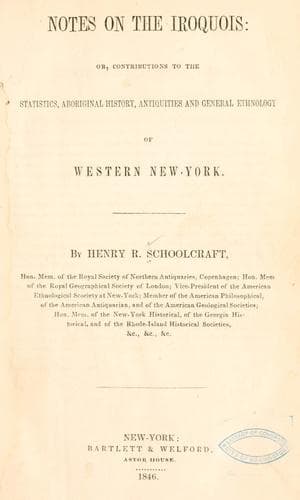
Notes on the Iroquois: or, Contributions to the Statistics, Aboriginal History, Antiquities and General Ethnology of Western New-YorkSchoolcraft, Henry Rowe
History
Notes on the Iroquois: or, Contributions to the Statistics, Aboriginal History, Antiquities and General Ethnology of Western New-York
Schoolcraft, Henry Rowe
Indians of North America -- New York (State); Iroquois Indians
To the Twankannas, the Neuter Nation, and other tribes and bands, not
being Eries, who lived in this portion of the State, the Iroquois
applied the general term of Adirondacks,[38] a bold, warlike, northern
race, who spread over many degrees of latitude and longitude in
former days, covering, by generic affiliation with other tribes, all
New-England and the Atlantic coast, to North Carolina, and who are
still, in their numerous and subdivided descendants, in the upper lakes
and the west, the most numerous of any of the aboriginal stocks yet
existing east of the Mississippi and Missouri. So long as the Iroquois
remained divided, the Eries and their Algonquin allies kept their
ground; and there is no reason to believe that they began to decline
until a considerable period after the era of the Onondaga league. That
league was at first but little more than an agreement to stand by each
other, and to send delegates and forward news to a central council;
but it put an end to intestine wars, and its popular capacities soon
developed themselves, and made it formidable to their neighbors. Thus
much by way of prelude to their wars, to be noticed hereafter.
[38] Called Algonquins by the French.
The Senecas were from the earliest times the most powerful of the
Iroquois, nearly doubling, in its best estate, the Mohawks. Their
population in past days has been variously estimated, and often
exaggerated. Perhaps Dalton, who puts it at 400 warriors, or 2,000
souls, during the American war, verges to the opposite extreme,
and actually underrates it. Be this as it may, I found the entire
Seneca population, within the State, to be 2,383, residing on four
reservations in the counties of Niagara and Genesee, Erie, Chautauque,
Cattaraugus and Alleghany. They were found to be divided into 538
families, who cultivated, in the aggregate, 8,416 acres of land. The
produce of this land, as near as it could be obtained, as some declined
stating it, was 21,341 bushels of corn, 3,745 of wheat, 20,039 of
oats, and 12,469 of potatoes, besides buckwheat, turneps, peas, and
smaller articles. They possess 1,537 neat cattle, 510 milch cows, 626
horses, 335 sheep, and 2,269 hogs. Other details of their advance in
agriculture were equally flattering. They cut large quantities of
meadow land, possess an adequate supply of farming utensils, carts,
wagons, including many tasty buggies and sleighs. Very little of their
means of subsistence, even in the most unfavored positions, is derived
from the chase. Upwards of 4,000 fruit trees were counted. The style of
their buildings, fences and household furniture, as well as the dress
of the males, is not essentially different, and little, often nothing
at all, inferior to that of their white neighbors. Temperance and
temperance societies exist in a good state in each canton. Fifteen of
their youth have received a collegiate or academic education. A number
of these have studied professions. About 350 of the children attend
Public-domain text, read in full here on John Shaqi.
Reviews
Reviews
No reviews yet
Be the first to share your thoughts on this work.
Join the Discussion
Join the discussion
Sign in to leave a comment or review.
Sign InorCreate an account