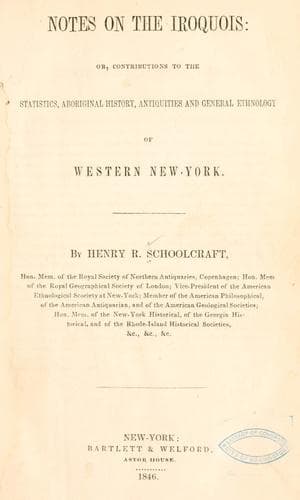
Notes on the Iroquois: or, Contributions to the Statistics, Aboriginal History, Antiquities and General Ethnology of Western New-YorkSchoolcraft, Henry Rowe
History
Notes on the Iroquois: or, Contributions to the Statistics, Aboriginal History, Antiquities and General Ethnology of Western New-York
Schoolcraft, Henry Rowe
Indians of North America -- New York (State); Iroquois Indians
The fort was immediately deserted, and all who had escaped went with
their deliverer to, and fixed their council fire on, the west shores of
Seneca lake, where Geneva now stands.
The general course of the migration and conquests of the Senecas has,
however, been towards the west. Taking their own general and ancient
traditions of the parent stock, to wit, their origin in the valley of
the Oswego, they may be supposed to have followed the Seneca branch
of those outspread waters to the banks of the Seneca and Canandaigua
lakes, and thence into the rich valley of the Genesee. At an early day
they were limited to the region east of this capital stream, which,
crossing the country in a transverse direction, formed a natural
boundary. There lived west of it, in ancient times, a tribe who are
known as Alleghans, Andastes and Eries, or, as the Senecas call them,
Kah-Kwahs. They had their council fires at or near Buffalo, extending
west and also east. The people called by the French the Neuter
Nation, had placed themselves, so far as we can learn, on the waters
of Oak-Orchard creek, which draws its tributaries in part from the
fertile districts of Genesee, Niagara and Orleans counties. From the
accounts of the Tuscaroras, [D.] this people were governed in early
times by a queen, who ruled over twelve forts in that quarter. North
of them, embracing the Niagara ridge and the country below it, dwelt a
branch of the Algonquin nation, who are called by the same authority,
TWANKANNAH. Other names occur, which are believed to be either
synonymes for these, or minor divisions of the three principal tribes
named, of which some further notice will be taken in a subsequent paper
on the antiquarian remains of the country.
That these Trans-Genesean people were populous and warlike, not only
maintaining their grounds against the Senecas, but often defeating
them and driving them back, is proved not only by the traditions
of the Senecas themselves, but by the striking evidences of their
military strength and skill, denoted by the remains of forts and
intrenchments and cemeteries, yet existing throughout the extensive
area, included between the Genesee and the Niagara, extending up the
southern shores of Lake Erie to Chautauque and the other principal
known Indian routes to the waters of the Alleghany and Ohio. There is,
at least, one authority[37] for believing that the Eries themselves
were remotely descended from the Senecas, and we have living tradition
to prove [VIII.] that, at the time of their final defeat and so called
extermination, some of them fled west, whilst the remainder of them,
scattered, cut up and depressed, were incorporated in the Seneca canton.
[37] Cusick.
Public-domain text, read in full here on John Shaqi.
Reviews
Reviews
No reviews yet
Be the first to share your thoughts on this work.
Join the Discussion
Join the discussion
Sign in to leave a comment or review.
Sign InorCreate an account